

Why Gold Is Falling During a Global Debt Crisis? 7 Surprising Reasons You Need to Understand
- account_circle Taylor Kenney, Doug Casey
- calendar_month Kamis, 1 Okt 2026
- visibility 11
- comment 0 komentar
- print Cetak

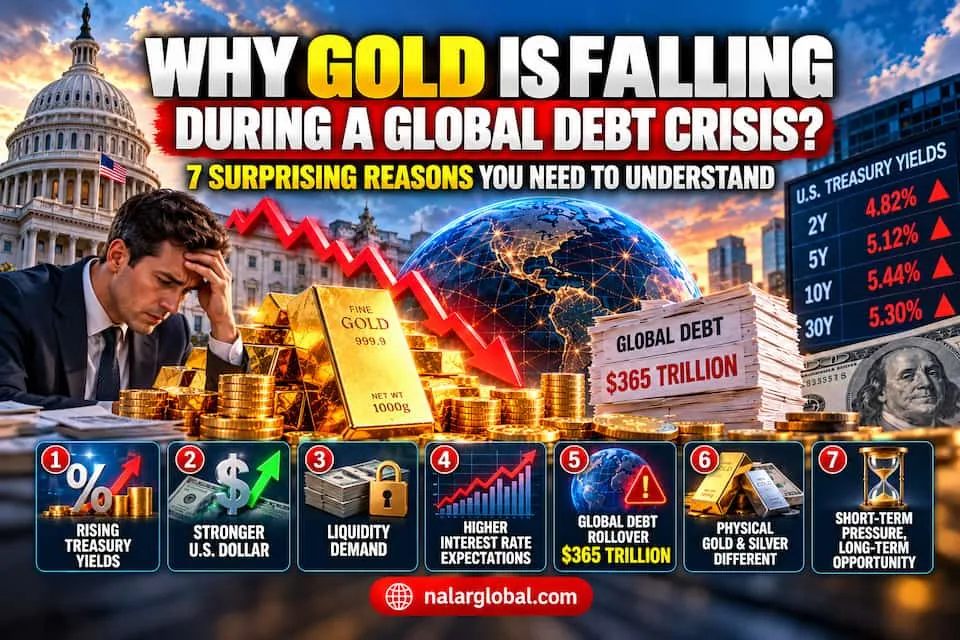
Why Gold Is Falling During a Global Debt Crisis
info Atur ukuran teks artikel ini untuk mendapatkan pengalaman membaca terbaik.
Why is gold falling during a global debt crisis when gold is traditionally viewed as a store of value during periods of financial uncertainty?
Quick Answer
Why gold is falling during a global debt crisis can be explained by several short-term forces, including rising Treasury yields, stronger demand for dollars, tighter liquidity, and changing interest-rate expectations. Taylor Kenney argues that these pressures can temporarily weigh on gold even while the underlying debt problem becomes more serious. Doug Casey similarly says gold should be viewed from a longer historical perspective rather than judged by daily or weekly price movements.
There is a moment that can make an investor stop and stare at a market screen.
Debt headlines are getting louder. Bond yields are rising. Governments are facing increasingly expensive financing. Yet the gold price is falling.
That apparent contradiction is exactly why so many people are asking: why gold is falling during a global debt crisis when gold is supposed to offer protection during monetary and financial stress.
Taylor Kenney, a Monetary Analyst at ITM Trading, addressed that question in a September 29, 2026 presentation titled The Global Debt Crisis Has Begun (Why Gold Is Falling First). The discussion focuses on Treasury yields, the cost of servicing U.S. debt, global debt rollover risks, confidence in government debt, and why short-term weakness in gold may not tell the whole story.
Two days later, ITM Trading published an interview with Doug Casey, founder of Casey Research and author of Crisis Investing. Casey explained that he has been buying gold since the early 1970s and has generally treated it as a savings vehicle. He also emphasized that he does not focus heavily on gold’s daily, weekly, or monthly fluctuations.
The result is a more complicated picture than the simple assumption that “debt crisis equals rising gold.”
Why Gold Is Falling During a Global Debt Crisis: The Short-Term Picture
The first thing to understand is that gold does not move according to a single economic variable.
The question why gold is falling during a global debt crisis becomes easier to understand when short-term market forces are separated from longer-term concerns about debt and currencies.
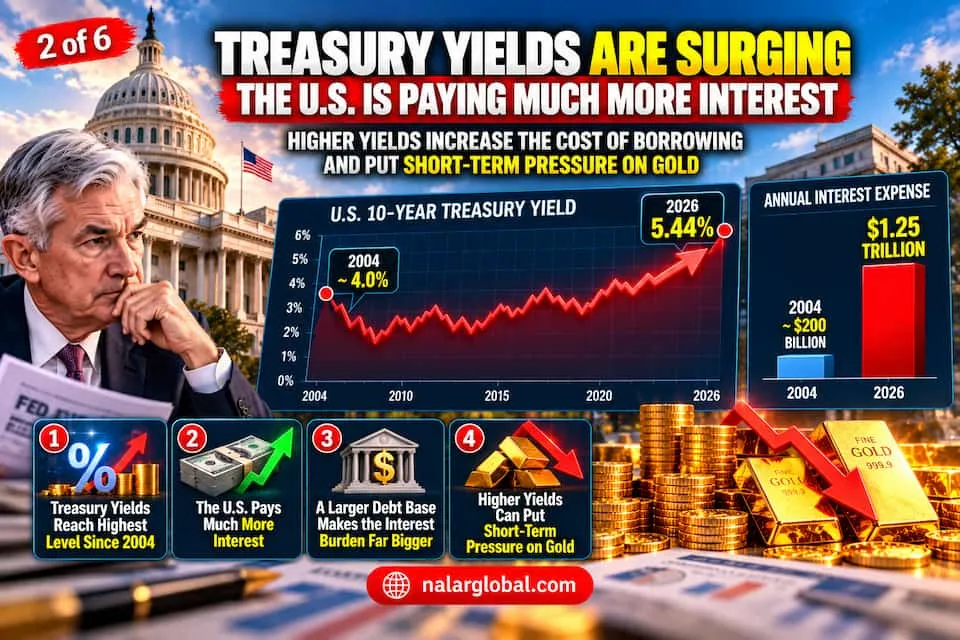
Taylor Kenney points to the bond market as an important starting point. In his presentation, he says U.S. Treasury yields had reached their highest level since 2004 and connects higher yields with a higher cost of borrowing for the U.S. government.
That matters because gold does not pay interest or a coupon.
When yields on interest-bearing assets rise, investors may reassess the relative attractiveness of holding an asset that does not generate a regular cash return. This does not mean gold has suddenly lost its monetary role; it means the opportunity cost of holding it can change.
1. Rising Treasury Yields Can Put Pressure on Gold
One major clue to why gold is falling during a global debt crisis is the sharp movement in bond yields.
Kenney describes Treasury yields as essentially the interest cost associated with government borrowing. According to the figures presented in his video, annual net interest expenses on U.S. government debt had reached approximately $1.2 trillion to $1.25 trillion.
The important issue is not simply that yields are rising.
It is what happens when higher yields are applied to a very large debt base.
Kenney contrasts the roughly $7 trillion U.S. debt level he references for 2004 with a debt level of roughly $40 trillion in the period discussed. His argument is that a similar interest rate applied to a dramatically larger debt balance produces a very different financial burden.
For ordinary Americans, the concept can be understood through a household analogy.
If a family has a $10,000 loan, a modest increase in the interest rate may be manageable. If the same rate increase is applied to a $1 million obligation, the additional interest can become substantial.
Government debt operates on a much larger scale, but the basic arithmetic remains relevant.
2. Higher Yields Can Make Interest-Bearing Assets More Competitive
Another part of the answer to why gold is falling during a global debt crisis involves the relative appeal of assets that generate income.
Gold can store value, but it does not pay a fixed interest rate simply because someone owns it. Treasury securities and other interest-bearing instruments are different because they provide contractual payments under their terms.
When yields rise, some investors may therefore shift toward interest-bearing assets.
This can happen even while the underlying reason for higher yields is itself a source of concern.
That distinction is important. A rising Treasury yield can simultaneously make bonds more attractive relative to gold in the short term while increasing the government’s financing burden over time.
3. The Dollar and Interest-Rate Expectations Can Change Gold’s Direction
The third piece of the puzzle is the U.S. dollar.
Kenney argues that short-term expectations surrounding interest rates and dollar strength can contribute to weakness in gold. He describes this as part of the short-term mentality that can obscure the longer-term monetary picture.
When investors expect relatively higher U.S. interest rates, dollar-denominated assets can become more attractive. If demand for dollars rises while liquidity is tight, gold can face additional pressure.
This helps explain why the market can send a confusing signal.
The headlines may focus on government debt and inflation concerns, while traders are simultaneously responding to currency movements, interest-rate expectations, and immediate liquidity conditions.
The Bigger Question Is Not Only What Gold Does Today
This is where Doug Casey’s perspective becomes important.
Casey says he does not worry about gold’s daily, weekly, or monthly fluctuations. Instead, he prefers to examine monetary and financial developments from a historical perspective.
He describes gold as a savings device and argues that it is different from a conventional financial asset because, in his view, it is not simultaneously someone else’s liability.
That distinction does not guarantee that gold will rise.
It does, however, explain why Casey does not interpret a short-term gold decline as proof that the broader debt story has disappeared.
The Debt Rollover Problem Behind the Headlines
The next major part of understanding why gold is falling during a global debt crisis is the debt rollover problem.
Kenney describes global debt at approximately $365 trillion in the presentation and explains that debt has maturity dates. When existing obligations come due, borrowers must either repay them or refinance them.
Governments have an additional mechanism available: issuing new debt to refinance existing obligations.
But refinancing becomes more expensive when new borrowing carries higher yields.
Why Debt Rollover Matters
Imagine a homeowner whose mortgage comes due and must be refinanced.
If the new interest rate is significantly higher, the monthly financial burden can increase even though the principal balance has not suddenly doubled.
Kenney applies a similar logic to government debt. When older obligations are rolled over at higher yields, the cost of servicing the debt can rise.
This is one reason the answer to why gold is falling during a global debt crisis cannot be found by looking at the gold chart alone.
The gold price is one piece of a much larger financial system.
The bond market, interest rates, currency markets, liquidity conditions, government deficits, and debt maturities all interact.
And according to Kenney, this is not only a U.S. issue. His presentation points to rising bond yields across several major economies and describes the situation as a broader global debt problem.
4. Confidence in Government Debt Can Become a Critical Factor
Another important part of understanding why gold is falling during a global debt crisis is confidence.
Taylor Kenney argues that government debt ultimately depends on confidence that creditors will be repaid in money that retains meaningful value. In his discussion, he points to rising yields as a possible signal that investors are demanding greater compensation for holding government debt.
This is a crucial distinction.
A government bond may be legally valid, but investors still care about the purchasing power of the currency in which they will eventually be repaid. If concerns about inflation or currency depreciation increase, the market can demand higher yields.
Government Debt Is Ultimately Built on Trust
Kenney presents a strong argument that government borrowing depends on confidence. His discussion characterizes the problem as more than a simple accounting exercise: lenders must believe that the debt will be serviced and that the currency used for repayment will retain value.
Doug Casey approaches the same issue from a historical perspective.
Casey argues that gold’s attraction comes partly from the fact that physical gold is not simultaneously a liability owed by another party. He contrasts that characteristic with many financial claims that depend on another institution, government, or counterparty fulfilling an obligation.
This is central to the speakers’ long-term argument about gold.
It also explains why why gold is falling during a global debt crisis is not necessarily the same question as whether gold has a role in a long-term wealth-preservation strategy.
5. Inflation Can Become Part of the Debt Problem
The fifth reason in the discussion is inflation.
Kenney argues that when governments face persistent deficits and large debt burdens, inflation can become one possible mechanism through which the real burden of debt is reduced. He describes this as a form of “stealth” default, because the nominal debt may still be repaid while the purchasing power of the currency changes.
That is a serious claim and should be understood as the speakers’ interpretation of the monetary system rather than as a guaranteed forecast.
For an American household, the practical issue is easier to understand.
If wages rise more slowly than the prices of groceries, housing, insurance, transportation, and other necessities, a household can feel financially poorer even if its nominal income has increased.
Why Inflation Changes the Gold Debate
This is another reason why gold is falling during a global debt crisis can seem confusing.
If inflation is a long-term concern, investors might expect gold to benefit. But markets do not necessarily price long-term risks immediately.
Short-term positioning can be dominated by interest rates, liquidity, the dollar, leverage, and investor sentiment.
Kenney explicitly argues that this short-term perspective can make gold’s current weakness appear inconsistent with the longer-term debt and monetary picture.
In other words, a falling gold price does not automatically settle the debate about inflation.
Nor does it prove that a future inflationary episode will occur.
6. Physical Gold and Silver Are Different From Financial Claims
The sixth reason why gold is falling during a global debt crisis matters particularly to investors who distinguish between physical precious metals and financial products linked to them.
Taylor Kenney emphasizes physical gold and silver as assets that do not depend on a financial institution’s promise in the same way as a conventional financial claim.
Doug Casey makes a similar distinction.
He says he has continued accumulating gold because he considers it a financial asset that is not simultaneously somebody else’s liability. He also notes that gold should not be viewed as a magical protection against every financial problem.
Gold Is Not a Guaranteed Investment
This point is easy to miss.
When discussing why gold is falling during a global debt crisis, it would be misleading to turn the argument into “gold always goes up during a crisis.”
That is not what Casey says.
In fact, Casey describes gold as a savings asset rather than a conventional productive investment. He also says that gold’s role today is different from what it was decades ago because its price relative to other goods and assets has changed.
He additionally distinguishes gold from more speculative assets such as small mining companies, which he describes as highly volatile and risky.
For ordinary households, the lesson is straightforward: an asset can have a useful role without being risk-free.
7. Gold Can Fall Before the Longer-Term Debt Story Becomes Visible
The seventh and perhaps most important reason why gold is falling during a global debt crisis is timing.
Markets do not always move in the same direction as the underlying economic narrative.
Taylor Kenney argues that gold’s short-term decline should not be confused with the longer-term thesis surrounding debt, currencies, and monetary cycles. He says that looking only at what gold is doing today can create a short-term view that misses the larger historical pattern.
Doug Casey makes a similar point from a different angle.
He says he does not attempt to predict gold’s daily or weekly movements and instead evaluates monetary developments through a historical lens.
This does not prove that gold must rise next.
It simply means that the speakers do not consider a short-term decline sufficient evidence that the underlying debt problem has disappeared.
What Does This Mean for American Households?
The discussion of why gold is falling during a global debt crisis ultimately leads to a more practical question: what should ordinary Americans do with this information?
The two speakers emphasize preparation, but their views are not identical and their recommendations should be understood within the context of their broader investment philosophies.
Taylor Kenney encourages viewers to have a plan for the debt environment and emphasizes physical precious metals as part of the approach promoted by ITM Trading.
Doug Casey takes a broader approach, arguing that individuals should focus on actions within their own control rather than assuming they can solve large-scale economic problems themselves.
Recommended Actions to Take ✔️
✔️ First Recommendation. Build and maintain an adequate emergency fund so unexpected financial pressure does not immediately force the sale of long-term assets.
✔️ Second Recommendation. Understand how much debt your household carries, including credit cards, student loans, mortgages, and other variable-rate obligations.
✔️ Third Recommendation. Continue educating yourself about inflation, interest rates, Treasury yields, currency movements, and the risks associated with different asset classes.
✔️ Fourth Recommendation. If you consider precious metals, understand the difference between physical gold, financial products linked to gold, mining stocks, and other forms of exposure before making a decision.
✔️ Fifth Recommendation. Diversify your financial plan rather than relying entirely on one asset, one institution, one income source, or one economic scenario.
Things to Avoid ❌
❌ First. Do not assume that a falling gold price proves the global debt problem has disappeared.
❌ Second. Do not assume that gold is guaranteed to rise simply because debt or inflation concerns are increasing.
❌ Third. Do not take on excessive debt simply to purchase an asset because you expect its price to rise.
❌ Fourth. Do not treat a commentator’s forecast as a certainty or substitute for understanding your own financial circumstances.
❌ Fifth. Do not make major financial decisions based solely on fear generated by dramatic headlines or short-term market movements.
The Bigger Picture Behind Gold’s Decline
The central question why gold is falling during a global debt crisis becomes less mysterious when the market is viewed as a system rather than a single price chart.
Treasury yields can rise. The dollar can strengthen. Investors can seek liquidity. Interest-rate expectations can change. At the same time, governments can face larger refinancing costs as existing debt matures.
These forces can operate simultaneously.
Taylor Kenney’s argument is that investors should not confuse the short-term behavior of gold with the longer-term debt cycle. His presentation describes rising yields, growing global debt, refinancing pressure, and concerns about confidence in government debt as connected developments.
Doug Casey reaches a related conclusion from a historical perspective. He says gold has served as his savings vehicle for decades and continues to view it as an asset with characteristics that differ from conventional financial claims.
The important takeaway is not that gold must rise tomorrow.
The more useful lesson is that why gold is falling during a global debt crisis cannot be answered by looking at gold alone.
Investors need to watch the interaction between debt, bond yields, currencies, inflation expectations, liquidity, and market sentiment.
For American families, the practical response is preparation rather than panic.
A household cannot control Treasury yields or global debt levels. It can, however, control how much debt it takes on, how much emergency liquidity it maintains, how it diversifies its assets, and how carefully it evaluates financial claims.
The debt debate may continue for years. Gold may rise and fall along the way. Understanding both facts is more useful than assuming either one has a simple, guaranteed outcome.
Conclusion
The question why gold is falling during a global debt crisis has no single-cause answer. The material from Taylor Kenney and Doug Casey points to several forces that can operate simultaneously: rising Treasury yields, changing interest-rate expectations, dollar strength, liquidity conditions, investor positioning, and the growing cost of refinancing debt.
Taylor Kenney argues that the short-term decline in gold should not be interpreted as proof that the underlying debt problem has disappeared. His presentation highlights rising U.S. and global bond yields, a large debt rollover requirement, and increasing interest expenses.
Doug Casey takes a longer historical view. He says he has accumulated gold since the early 1970s and does not focus on its daily or weekly fluctuations. For Casey, gold’s role is primarily connected to saving and its distinction from financial assets that represent another party’s liability.
The practical lesson is therefore not that Americans should assume gold must rise or that a financial collapse is guaranteed. Instead, why gold is falling during a global debt crisis should encourage investors to look beyond one price chart and understand the interaction between debt, yields, currencies, inflation, liquidity, and risk.
For American households, preparation means managing debt carefully, maintaining liquidity, continuing financial education, and understanding the risks of every asset before investing.
Why gold is falling during a global debt crisis is ultimately a question about timing and market structure. A falling price today does not by itself resolve the longer-term debate about debt and monetary stability.
This article is for educational purposes only. Please review our full disclaimer: http://nalarglobal.com/en/disclaimer before applying any information.
Frequently Asked Questions
1. Why is gold falling during a global debt crisis?
Why gold is falling during a global debt crisis can be partly explained by rising Treasury yields, changing interest-rate expectations, dollar strength, liquidity conditions, and investor positioning. These forces can pressure gold even while debt concerns remain elevated.
2. Shouldn’t gold rise during a debt crisis?
Not necessarily. Gold does not automatically rise every time debt concerns increase. Short-term markets can be dominated by interest rates, currency movements, liquidity needs, and investor positioning.
3. How do Treasury yields affect gold?
Higher Treasury yields can increase the relative appeal of interest-bearing assets. Because gold does not pay a conventional coupon, investors may reassess its opportunity cost when yields rise.
4. What is the global debt rollover problem?
Debt rollover occurs when existing debt reaches maturity and must be repaid or refinanced. Kenney argues that refinancing becomes more expensive when new debt carries higher yields.
5. How much global debt does Taylor Kenney discuss?
Kenney cites approximately $365 trillion in global debt in his presentation and connects the figure to the broader debt rollover problem.
6. Why does Doug Casey continue to hold gold?
Casey says he has accumulated gold since the early 1970s and treats it primarily as a savings device. He emphasizes that physical gold is not simultaneously another party’s liability.
7. Does a falling gold price mean the debt crisis is over?
No. A decline in gold is a market observation, not proof that the underlying debt situation has been resolved. Debt levels, refinancing costs, fiscal conditions, and market confidence require separate analysis.
8. Is gold guaranteed to rise if inflation increases?
No. The sources do not establish a guaranteed price outcome. Casey himself says gold should not be treated as a magical protection or as a conventional productive investment.
9. Should Americans put all their savings into gold?
The sources do not establish that all Americans should do so. Both discussions emphasize the importance of understanding risk and the broader financial environment. A household’s financial position, liquidity needs, time horizon, and risk tolerance all matter.
10. What should Americans watch besides the gold price?
Investors can monitor Treasury yields, inflation, interest-rate expectations, the U.S. dollar, government debt issuance, refinancing needs, and broader liquidity conditions. Looking at several indicators provides more context than watching gold alone.
Summary
Why gold is falling during a global debt crisis is one of the most confusing questions facing investors when debt headlines intensify while gold prices move lower. The discussions by Taylor Kenney and Doug Casey offer a framework for understanding why these two developments can occur at the same time.
Kenney focuses heavily on the bond market. His presentation discusses U.S. Treasury yields at their highest level since 2004 and annual net interest expenses of approximately $1.2 trillion to $1.25 trillion. He argues that higher yields matter because the United States must refinance a very large amount of existing debt, potentially increasing the cost of servicing that debt.
The discussion also expands beyond the United States. Kenney cites approximately $365 trillion in global debt and describes a worldwide rollover problem as debt reaches maturity and must be refinanced.
So, why gold is falling during a global debt crisis cannot be explained simply by saying that gold has stopped functioning as a store of value. Short-term movements can reflect Treasury yields, dollar strength, interest-rate expectations, liquidity, and investor behavior.
Casey approaches the subject differently. Having accumulated gold since the early 1970s, he says he focuses on historical patterns rather than daily or weekly price changes. He describes gold primarily as a savings asset and emphasizes its distinction from financial claims that represent another party’s liability.
The central lesson is that why gold is falling during a global debt crisis should not be reduced to a prediction about tomorrow’s price. The more important question is how debt, yields, currencies, inflation, liquidity, and investor confidence interact.
For Americans, that means focusing on financial resilience rather than panic: manage debt, maintain emergency liquidity, diversify appropriately, and understand what you own. A falling gold price may be significant, but it is only one piece of a much larger financial picture.
Meta Description
Why gold is falling during a global debt crisis? Discover 7 key reasons involving Treasury yields, liquidity, the dollar, debt rollover, and investor behavior.
References
YouTube
• Taylor Kenney — Monetary Analyst, ITM Trading. The Global Debt Crisis Has Begun (Why Gold Is Falling First) — September 29, 2026.
• Doug Casey — Writer and Founder, Casey Research. Why Gold Falls First | Doug Casey: That’s When the Bigger Crisis Starts — October 1, 2026.



- Penulis: Taylor Kenney, Doug Casey
- Editor: TRS
- Sumber: https://www.youtube.com/watch?v=B85ovGqU2nA












Saat ini belum ada komentar