

Prediction of Global Financial Collapse : 7 Alarming Risks Professor Jiang Says Could Reshape America and the World
- account_circle daffa313
- calendar_month Jumat, 21 Agt 2026
- visibility 104
- comment 0 komentar
- print Cetak


Prediction of Global Financial Collapse
info Atur ukuran teks artikel ini untuk mendapatkan pengalaman membaca terbaik.
Prediction of Global Financial Collapse: What Could Trigger It?
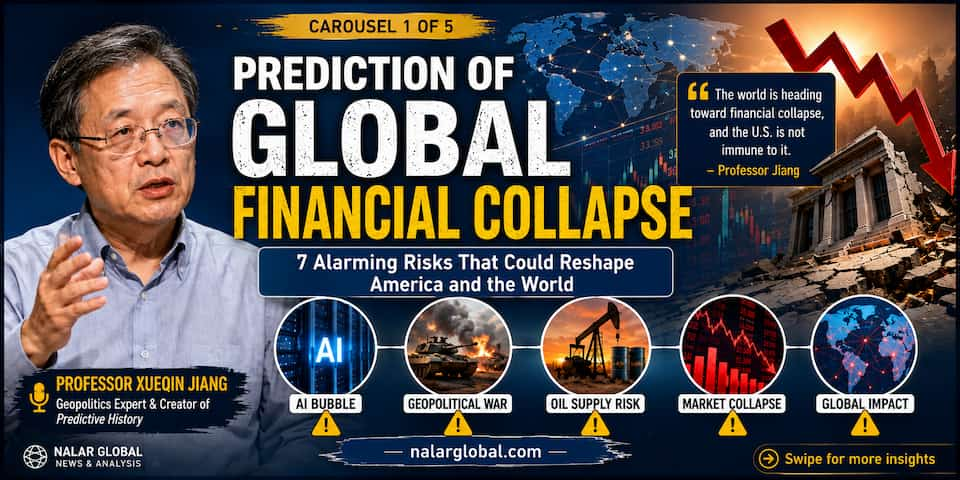
Quick Answer: The Prediction of Global Financial Collapse presented by Professor Xueqin Jiang points to several interconnected risks: a potential AI investment bubble, geopolitical escalation, energy disruption, international trade pressure, and financial instability. Jiang argues that the United States is heading toward financial collapse and warns that the AI boom could become an important trigger if massive infrastructure investments fail to generate sufficient returns.
For many Americans, financial collapse sounds like something that happens somewhere else. Yet modern economies are deeply connected. A shock to energy supplies, international trade, financial markets, or investment confidence can eventually reach businesses and households thousands of miles away.
Professor Jiang approaches these developments through game theory. He explains that understanding geopolitical behavior requires examining the structure of the situation, its rules, and the incentives facing each major player.
His analysis therefore connects events that may initially appear unrelated: war, oil, shipping, AI investment, global capital, and financial markets.
Who Is Professor Xueqin Jiang?
Professor Xueqin Jiang is a geopolitics commentator and creator of Predictive History. In his conversation with Theo Von, he discusses the conflict involving Iran, the United States, Israel, and other regional powers while explaining how he uses game theory to make geopolitical predictions.
His most significant financial warning comes when he is asked what he would do with money and assets. Jiang says he believes the world is heading toward financial collapse and specifically points to the AI bubble and massive investment in data centers.
Table of Contents
- Prediction of Global Financial Collapse: What Could Trigger It?
- Who Is Professor Xueqin Jiang?
- How War Could Become a Financial Crisis
- Why the Strait of Hormuz Matters
- The Escalation Ladder
- The AI Bubble: A Potential Financial Trigger
- Massive Investment, Uncertain Returns
- Seven Risks Behind the Prediction
- AI Investment Bubble
- Geopolitical Escalation
- Energy Supply Disruption
- International Trade Pressure
- Financial Market Uncertainty
- Multiple Crises Occurring Together
- Loss of Confidence
- The Role of Transnational Capital
- How Could Americans Feel the Impact?
- From Global Events to Household Pressure
- What Should Americans Do?
- Recommended Actions to Take
- Things to Avoid
- Conclusion
- Frequently Asked Questions
- Summary
- References



How War Could Become a Financial Crisis
The Prediction of Global Financial Collapse is not based solely on stock prices. Jiang’s argument is that geopolitical conflict can disrupt the physical systems on which the financial economy depends.
Why the Strait of Hormuz Matters
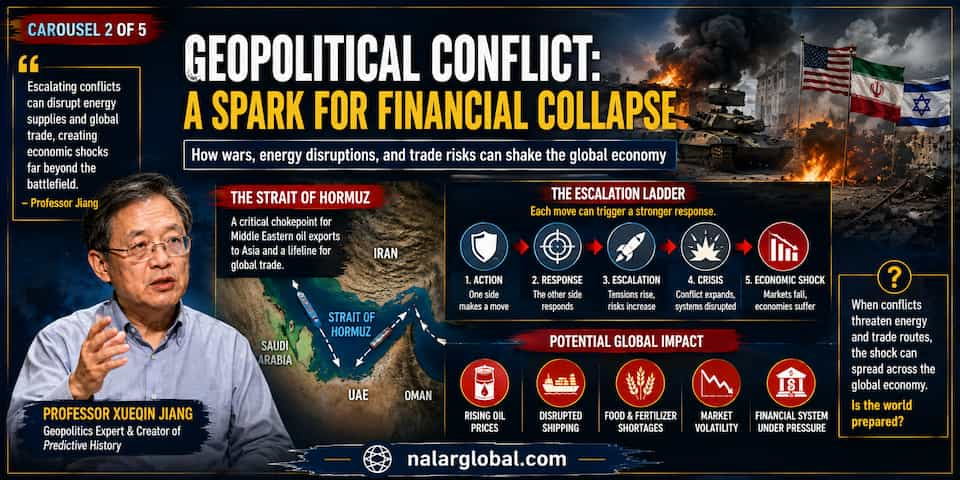
Jiang describes the Strait of Hormuz as a critical passage for oil exports from Persian Gulf countries to Asian markets. He also emphasizes that countries in the region depend on international trade for essential resources such as food and water.
A prolonged disruption could therefore affect more than oil. Higher energy and transportation costs can put pressure on businesses, consumers, manufacturing, agriculture, and international trade.
Jiang argues that a sufficiently severe loss of global oil supply could create conditions capable of producing economic collapse.
The Escalation Ladder
Jiang uses the idea of an “escalation ladder” to explain how one action can trigger another. Each response can create additional momentum and push a conflict toward increasingly serious stages.
From an economic perspective, escalation matters because every additional disruption can increase uncertainty, energy costs, shipping risks, and pressure on markets.
The AI Bubble: A Potential Financial Trigger
The strongest financial element of Jiang’s Prediction of Global Financial Collapse is his concern about the AI investment boom.
Massive Investment, Uncertain Returns
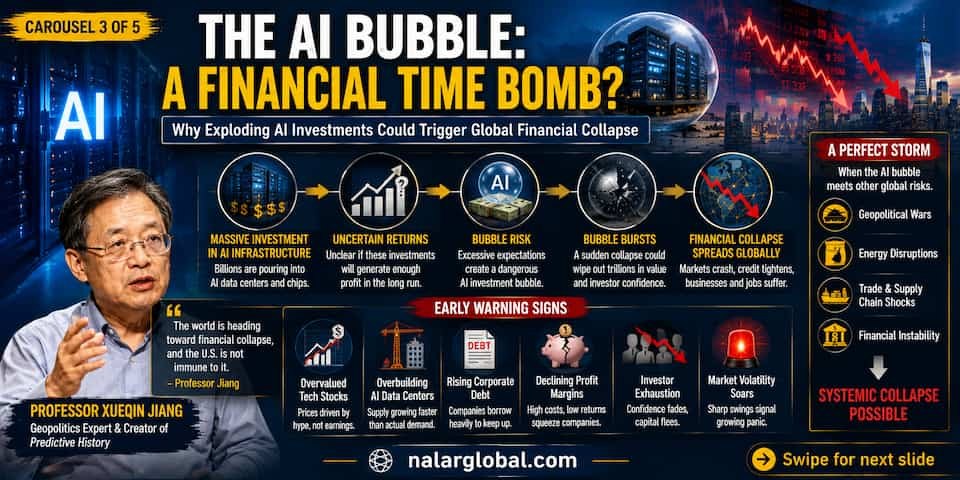
Jiang points to the enormous construction of AI data centers and questions whether these facilities will ultimately generate enough money to justify the capital being invested.
His concern is essentially about a mismatch between expectations and returns. If investors assume that AI-related companies and infrastructure will produce extraordinary profits, valuations and investment can rise rapidly.
But if expected profits fail to materialize, confidence can reverse.
A major correction in AI-related investments could therefore affect not only technology companies but also investors, lenders, businesses, and financial markets more broadly.
This is why Jiang views the AI bubble as a potential component of a much larger financial crisis rather than simply a technology-sector problem.
Seven Risks Behind the Prediction
The Prediction of Global Financial Collapse can be summarized through seven interconnected risks:
1. AI Investment Bubble
Massive spending on AI infrastructure could become problematic if expected returns fail to justify the investment.
2. Geopolitical Escalation
Jiang describes the conflict involving Iran as rapidly expanding and raises the possibility that it could become connected with the war in Ukraine.
3. Energy Supply Disruption
A serious disruption around the Strait of Hormuz could affect oil transportation and global energy markets.
4. International Trade Pressure
Energy, food, fertilizer, shipping, and other resources move through interconnected global supply chains. Disrupting one part can create pressure elsewhere.
5. Financial Market Uncertainty
When investors lose confidence, they can rapidly change their behavior, increasing volatility and reducing investment.
6. Multiple Crises Occurring Together
An AI correction alone could be disruptive. An AI correction combined with war, energy disruption, and trade problems could produce much greater systemic pressure.
7. Loss of Confidence
Ultimately, financial systems depend heavily on confidence. If businesses, investors, and households become increasingly pessimistic, spending and investment can weaken, reinforcing economic pressure.
The Role of Transnational Capital
Jiang also discusses what he calls transnational capital—money that can move across national borders in search of investment opportunities and profits.
This matters because modern financial markets are highly interconnected. Capital can move rapidly when investors believe one country, industry, or asset class has become too risky.
The same global connectivity that allows capital to flow efficiently can therefore transmit financial stress across borders.
How Could Americans Feel the Impact?
The Prediction of Global Financial Collapse becomes much more relevant when translated into everyday life.
A major financial shock could affect employment, borrowing, investments, business confidence, and household spending. If energy prices rise simultaneously, families could also face higher transportation and living costs.
The process may not look like an immediate “collapse.” It could begin with declining investment, weaker hiring, tighter credit, falling asset prices, or businesses becoming more cautious.
If these pressures reinforce one another, the economic slowdown could become increasingly difficult to reverse.
From Global Events to Household Pressure
The potential chain reaction is relatively simple:
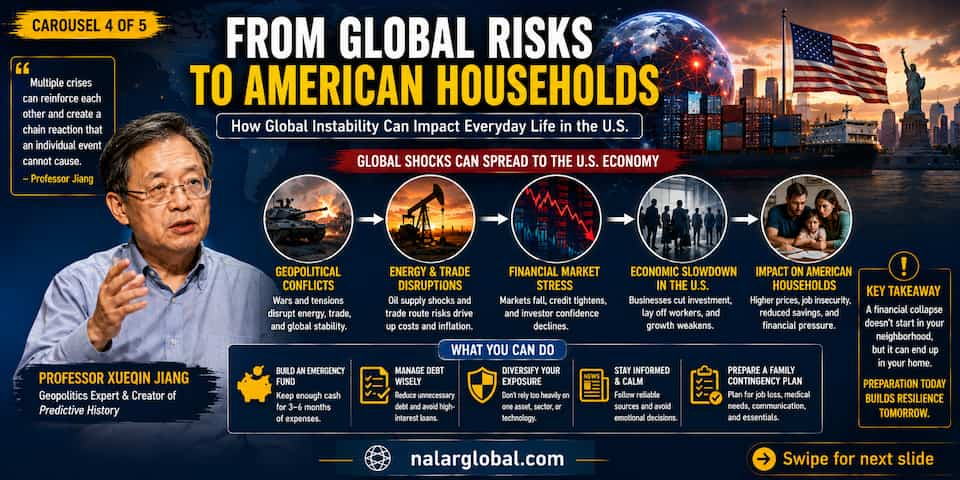
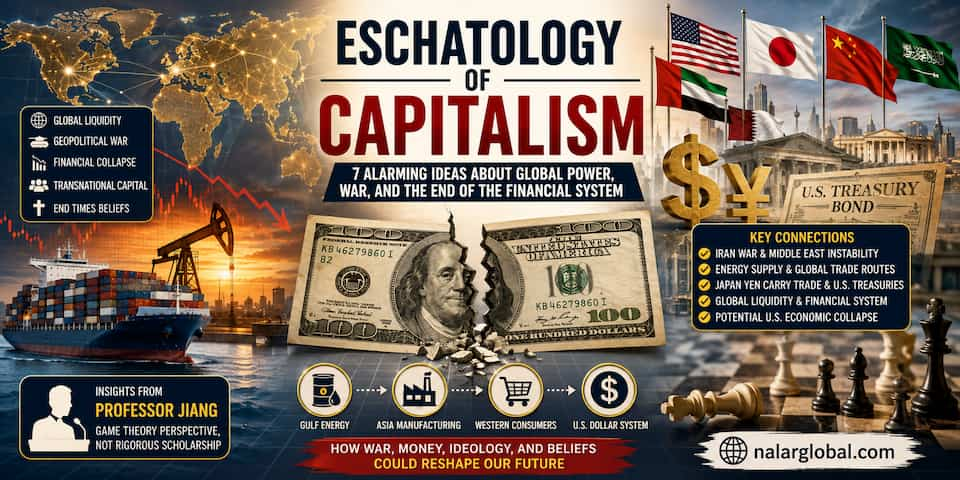
Geopolitical conflict → energy disruption → higher costs → financial-market stress → weaker business investment → economic slowdown → household pressure.
That is why Americans cannot always treat distant geopolitical events as irrelevant to their own finances.
What Should Americans Do?
Prediction of Global Financial Collapse

The purpose of studying a prediction like this should be preparation rather than panic.
Recommended Actions to Take✔️
✔️ First Recommendation — Build an emergency fund that can help cover essential expenses during temporary income disruption.
✔️ Second Recommendation — Manage debt carefully and avoid unnecessary high-interest borrowing.
✔️ Third Recommendation — Diversify financial exposure rather than depending entirely on one company, sector, or speculative technology.
✔️ Fourth Recommendation — Follow reliable information about markets, energy, geopolitics, and the economy without reacting emotionally to every headline.
✔️ Fifth Recommendation — Create a household contingency plan covering income disruption, essential expenses, insurance, communication, and emergencies.
Things to Avoid ❌
❌ First — Do not make panic-driven financial decisions because of dramatic predictions.
❌ Second — Do not put all your money into a speculative investment simply because its price is rising.
❌ Third — Do not assume any single asset is completely immune to a systemic crisis.
❌ Fourth — Do not take on excessive debt based on the assumption that income and asset prices will always rise.
❌ Fifth — Do not treat a prediction as a guaranteed outcome when making personal financial decisions.
Conclusion
The Prediction of Global Financial Collapse presented by Professor Xueqin Jiang is ultimately about interconnected risks. His warning combines the possibility of an AI investment bubble with geopolitical escalation, energy disruption, international trade pressure, and financial instability.
Jiang’s greatest financial concern is the enormous investment flowing into AI infrastructure. He questions whether data centers and other AI investments will generate enough money to justify their enormous costs and believes a bursting AI bubble could contribute to a broader financial crisis.
At the same time, geopolitical events could amplify financial pressure. The Strait of Hormuz is particularly important because of its role in transporting Middle Eastern oil toward Asian markets. A serious disruption could increase energy and transportation costs and affect economies far beyond the region.
For Americans, the central lesson is simple: prepare without panicking. Build financial resilience, manage debt carefully, avoid excessive concentration in speculative assets, maintain emergency resources, and stay informed.
The Prediction of Global Financial Collapse does not require Americans to assume that every warning will become reality. Instead, it highlights how financial, geopolitical, energy, and technological risks can interact. Understanding those connections can help households make more thoughtful decisions in an increasingly uncertain global economy.
Artikel ini hanya untuk tujuan edukasi. Silakan tinjau disclaimer lengkap kami: http://nalarglobal.com/en/disclaimer sebelum menerapkan informasi apa pun.
Frequently Asked Questions
1. What is the Prediction of Global Financial Collapse?
The Prediction of Global Financial Collapse discussed by Professor Xueqin Jiang describes a scenario in which financial instability is intensified by an AI investment bubble, geopolitical conflict, energy disruption, trade problems, and declining confidence in financial markets.
2. Why does Professor Jiang believe the United States could face financial collapse?
Jiang explicitly says he believes the United States is heading toward financial collapse. He connects this warning particularly to the rapid expansion of AI infrastructure and uncertainty over whether massive investments in data centers will generate sufficient returns.
3. How could an AI bubble trigger a financial crisis?
Jiang’s concern is that enormous amounts of capital are being invested in AI infrastructure while the eventual profitability of those investments remains uncertain. If expected returns fail to materialize, a sharp reversal in investor confidence could place pressure on financial markets.
4. Why is the Strait of Hormuz important to the global economy?
The Strait of Hormuz is a major energy chokepoint connecting Persian Gulf oil producers with Asian markets. Jiang argues that a serious disruption could affect oil supplies, trade, transportation, and economies well beyond the Middle East.
5. Could geopolitical conflict contribute to global financial collapse?
According to Jiang’s framework, yes. Conflict can disrupt energy supplies, shipping, trade, and investor confidence. He also discusses the possibility of separate conflicts becoming connected, potentially increasing the scale of the economic shock.
6. What is the escalation ladder?
Jiang uses the escalation ladder to explain how one action can trigger a response, which can lead to another escalation. In his analysis, this creates momentum that can push geopolitical conflicts toward increasingly dangerous stages.
7. What is transnational capital?
Jiang describes transnational capital as money capable of moving across national borders to seek investment opportunities and profits. He considers the movement of this capital important for understanding modern economic and geopolitical power.
8. How could a global financial crisis affect ordinary Americans?
Americans could potentially experience higher costs, weaker employment conditions, tighter credit, declining investments, reduced business activity, and greater financial uncertainty. The effects would depend on the severity and duration of the crisis.
9. Should Americans panic because of the Prediction of Global Financial Collapse?
No. The practical response is preparation rather than panic. Building financial resilience, reducing unnecessary debt, maintaining emergency resources, and avoiding emotionally driven investment decisions are more constructive responses.
10. Is the Prediction of Global Financial Collapse guaranteed to happen?
The prediction represents Professor Jiang’s assessment of how current risks could develop. It should not be confused with a guaranteed future event. The value of examining the prediction is understanding the potential chain of consequences and preparing responsibly.
SUMMARY
The Prediction of Global Financial Collapse presented by Professor Xueqin Jiang centers on the possibility that several major risks could converge and place extraordinary pressure on the global financial system. His warning begins with the rapidly expanding AI investment boom, particularly the enormous amount of capital being committed to data centers and other AI infrastructure. Jiang questions whether these investments will ultimately generate sufficient returns and argues that a bursting AI bubble could contribute to broader financial instability.
But Jiang’s argument goes far beyond artificial intelligence. Using game theory, he examines how major geopolitical players respond to incentives and to one another. His analysis connects the conflict involving Iran with broader risks involving the United States, Israel, Saudi Arabia, and potentially other theaters of conflict.
The Strait of Hormuz represents another critical vulnerability. Jiang emphasizes its importance for transporting Middle Eastern oil toward Asian economies. A prolonged disruption could therefore affect energy markets, shipping, trade, production, and consumer prices across the global economy.
The resulting chain could be powerful: geopolitical escalation could disrupt energy and trade; energy disruption could increase costs; financial uncertainty could reduce investment; and weakening investment could eventually affect employment and household finances.
For Americans, the most useful response is not fear. It is resilience. Building an emergency fund, managing debt, diversifying financial exposure, following reliable information, and preparing a household contingency plan can help families navigate uncertainty.
Ultimately, the Prediction of Global Financial Collapse is a warning about interconnected systems. A financial crisis does not necessarily have to begin inside America’s financial markets to affect American households. In a global economy, technology, energy, geopolitics, trade, and finance can influence one another. Understanding those connections gives people an opportunity to prepare before uncertainty becomes a personal financial emergency.
Meta Description: Prediction of Global Financial Collapse explained through Professor Jiang’s warnings about AI, war, oil, trade, and America’s financial risks.
REFERENCES
YouTube
• Professor Xueqin Jiang — High school teacher, geopolitics expert, and creator of Predictive History — “Professor Jiang | This Past Weekend w/ Theo Von #675” — Watch the episode on YouTube. The episode was published August 13, 2026 and covers Jiang’s geopolitical prediction methodology, the Middle East conflict, game theory, the Strait of Hormuz, and his financial-collapse warning. Link : https://www.youtube.com/watch?v=3cZN0OcSsqE
- Penulis: daffa313









Saat ini belum ada komentar