

Eschatology of Capitalism : 7 Alarming Ideas About Global Power, War, and the End of the Financial System
- account_circle daffa313
- calendar_month Jumat, 21 Agt 2026
- visibility 83
- comment 0 komentar
- print Cetak

Eschatology of Capitalism
info Atur ukuran teks artikel ini untuk mendapatkan pengalaman membaca terbaik.
Main Question: What Is the Eschatology of Capitalism?
Quick Answer
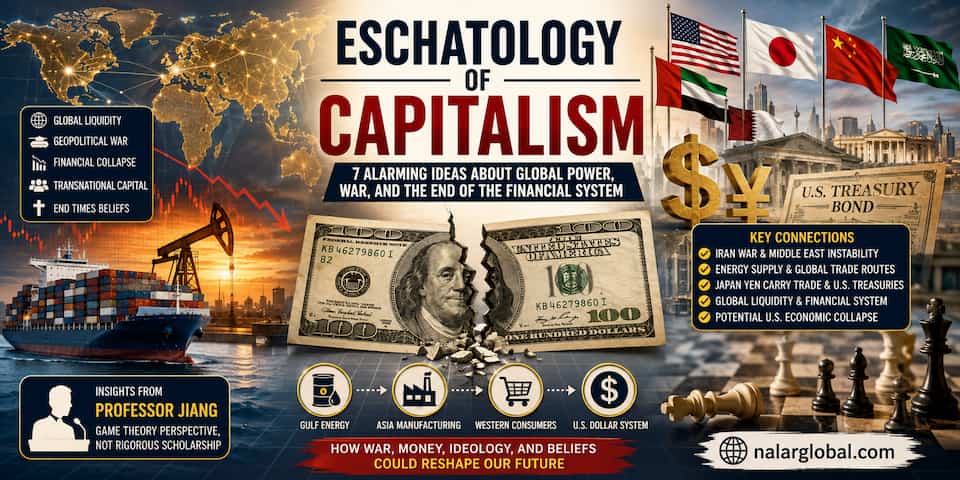
Eschatology of Capitalism is the idea that modern capitalism may be understood not only as an economic system but also through beliefs about history, destiny, and the future of humanity. In Professor Jiang’s lecture, the concept connects transnational capital, global financial liquidity, war in the Middle East, religious end-times beliefs, and the historical development of capitalism. His argument is presented as a game-theory interpretation rather than rigorous scholarship.
Imagine waking up one morning and realizing that the price of oil, the strength of the Japanese yen, U.S. Treasury markets, Middle Eastern shipping routes, and the future of the American economy may all be connected.
For most people, these subjects seem to belong to completely different worlds. A war belongs to geopolitics. Interest rates belong to central banks. The dollar belongs to finance. Religious prophecy belongs to theology.
Professor Jiang’s Eschatology of Capitalism attempts to place all of these pieces on the same board.
His central argument is deliberately provocative: the conflicts shaping the Middle East should not be understood solely through conventional theories of military power, resources, or national interests. Instead, he argues that the Iran war represents an eschatological conflict—one influenced by beliefs about the ultimate destiny of humanity and the end times.
That argument becomes even more consequential when Jiang connects the war to the architecture of the global economy.
He describes the modern system as resting on two major economic pillars: the energy-producing Gulf region, often referred to in the lecture as the GCC, and East Asia, which functions as a major manufacturing center. Energy moves toward East Asia, manufactured goods move toward Western consumers, while the U.S. dollar provides the financial framework connecting these flows.
From this perspective, a disruption in the Middle East is not merely a regional problem.
It can become a financial problem.
And a financial problem can become a problem for ordinary Americans.
Who Is Professor Jiang?
Professor Jiang is the speaker behind the lecture “Global Meet-Up #3 (New York City): The Eschatology of Capitalism,” delivered in New York City on August 15, 2026. The presentation lasted approximately two hours and thirty-five minutes.
Jiang explicitly tells the audience that he is approaching the subject through game theory rather than rigorous scholarship. He presents the ideas as an intuitive framework and encourages the audience to interrupt, question, and debate his assumptions.
That distinction matters.
The lecture should therefore be read as an intellectual argument and predictive framework rather than as an established academic consensus. The value of examining the Eschatology of Capitalism thesis lies partly in understanding how its different pieces are assembled into one sweeping explanation of capitalism, geopolitics, religion, and financial power.
Table of Contents
- What Is the Eschatology of Capitalism?
- The Global Economic System Behind the Argument
- Why the U.S. Dollar Matters
- Financialization, Inequality, Debt, and the American Economy
- How the Iran War Could Disrupt Global Liquidity
- Japan, the Yen Carry Trade, and U.S. Treasuries
- The Historical Origins of Transnational Capitalism
- Calvinism, Wealth, and the Development of Capitalism
- The Glorious Revolution and the Bank of England
- Transnational Capital and the Role of Secret Societies
- The Religious and Eschatological Dimension
- What the Theory Could Mean for Americans
- Recommended Actions to Take & Things to Avoid
- Frequently Asked Questions
- Conclusion
- Summary




The Global Economic System Behind the Eschatology of Capitalism
One of the most important foundations of Jiang’s argument is his description of the global economy as an interconnected system rather than a collection of independent national economies.
In his model, the Gulf Cooperation Council region supplies relatively inexpensive energy. East Asia uses that energy to manufacture goods, while Western economies consume those manufactured products. The U.S. dollar sits at the center of this arrangement because energy and manufactured goods are traded internationally in dollars, which are then recycled through the global financial system.
This creates an unusual position for the United States.
The dollar’s role as the world’s reserve currency gives the American financial system enormous importance, but Jiang argues that the same arrangement also creates vulnerabilities. In his view, the United States must maintain the free movement of dollars and global capital, even when doing so may conflict with narrower domestic economic interests.
The Eschatology of Capitalism framework therefore begins with finance before it reaches theology.
The argument is that the global financial architecture determines how economic power moves. Once that architecture is understood, Jiang believes the consequences of war, energy disruption, currency instability, and changing capital flows become easier to see.
Why Financialization Matters in the Eschatology of Capitalism
Jiang then turns to what he calls financialization.
His argument is that the United States gradually shifted away from resource extraction and manufacturing while becoming the financial center of the global economy. In his description, this process hollowed out parts of American productive capacity while increasing the importance of financial speculation.
He links this transformation to three major problems: corruption, inequality, and debt.
For ordinary Americans, this is where an abstract theory suddenly becomes personal. The question is no longer simply who controls global capital. It becomes whether the structure of global finance makes everyday households more vulnerable to debt, economic shocks, and widening inequality.
Jiang points to the 2008 financial crisis as a major symptom of this breakdown. He argues that the U.S. government rescued Wall Street while homeowners received less protection, creating what he describes as a K-shaped economy, in which different groups experience dramatically different economic outcomes.
This interpretation is central to his broader Eschatology of Capitalism thesis.
The system, in his view, can continue functioning for a long time while simultaneously becoming increasingly fragile.
And that raises the most important question of the lecture: what happens when a geopolitical shock strikes a financial system that is already dependent on constant global liquidity?
The Iran War and the Threat to Global Liquidity
Jiang argues that the Iran war could become a major disruption because the Middle East occupies a critical position in the global energy system.
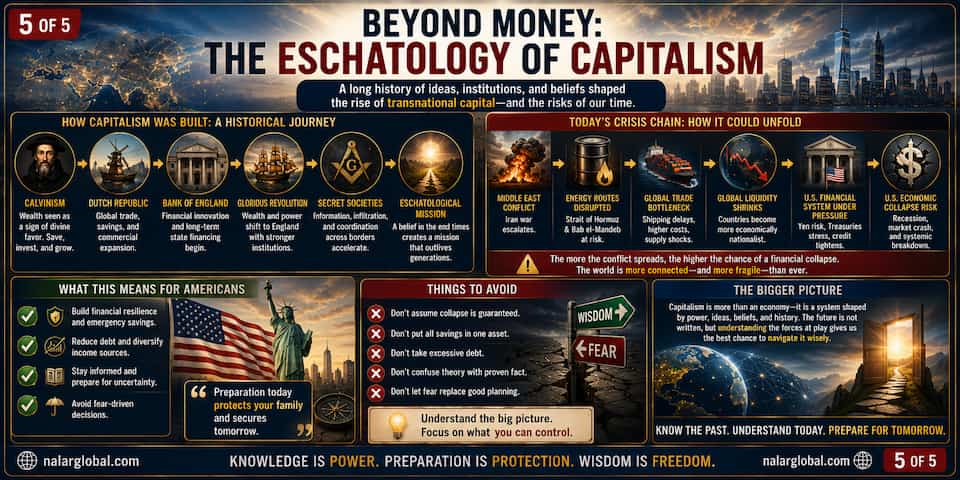
His lecture describes a chain reaction involving Iran, the Strait of Hormuz, the Houthis and the Bab el-Mandeb, Israel, Hezbollah, Iraq, Saudi Arabia, Turkey, and Pakistan. In his model, the more the conflict spreads, the greater the possibility of bottlenecks affecting energy and international trade.
The concern is not limited to oil prices.
Jiang argues that geopolitical instability could cause countries that currently recycle capital into global markets to become more economically nationalist. If that happened, he believes global liquidity could shrink.
That is where his economic prediction becomes especially severe.
According to Jiang’s framework, reduced liquidity could eventually place enormous pressure on the U.S. financial system and contribute to a U.S. economic collapse. He specifically connects this scenario to Japan, the yen carry trade, U.S. Treasuries, Gulf liquidity, China, and the broader global financial system.
The next part of the analysis therefore moves away from the battlefield and toward Tokyo, Washington, and the global bond market.
Japan, the Yen Carry Trade, and U.S. Financial Vulnerability
One of the most important links in the Eschatology of Capitalism argument is Japan.
Professor Jiang describes Japan as a major provider of liquidity to the global financial system through what is commonly known as the yen carry trade. In his presentation, Japanese borrowing costs are portrayed as extremely low, encouraging capital to move into higher-yielding assets such as U.S. Treasuries.
The mechanism matters because global markets can become dependent on capital that appears inexpensive and abundant.
Jiang argues that if geopolitical instability causes investors to lose confidence in the Japanese yen, the yen could weaken sharply. The resulting pressure could encourage Japanese financial institutions to pull capital back home, reducing liquidity available elsewhere.
In Jiang’s scenario, this is potentially dangerous for the United States because the American economy depends on continued access to global capital.
He connects this vulnerability with U.S. Treasury markets, Middle Eastern energy, China, Japan, and the growth surrounding artificial-intelligence infrastructure. His conclusion is stark: if geopolitical conflict causes major sources of global liquidity to become more nationally focused, the resulting liquidity shortage could contribute to a U.S. economic collapse.
That is one of the most dramatic predictions contained in the lecture.
Why the U.S. Dollar Sits at the Center of the Argument
The Eschatology of Capitalism framework also depends heavily on the special role of the U.S. dollar.
Jiang argues that energy producers in the Gulf and manufacturing economies in East Asia recycle dollars into the American financial system. This recycling can occur through multiple channels, including investments beyond the stock market itself.
That distinction is important because foreign capital does not have to flow directly into U.S. stocks to influence American financial conditions.
Jiang specifically points to hedge funds and real estate as additional destinations for global capital.
Under this interpretation, the dollar’s global role creates both extraordinary power and extraordinary dependence.
The United States benefits from having its currency at the center of international finance. But the same position means that disruptions in global trade, energy, currencies, or capital flows can reverberate through American markets.
This is why Jiang describes the dollar system as a structural issue rather than simply a currency issue.
From Financial Capitalism to Transnational Capital
The lecture then moves backward through history.
Jiang argues that modern capitalism was not created by one person or through one deliberate master plan. Instead, he describes it as the result of several historical developments that gradually converged.
His historical narrative begins with Calvinism and the doctrine of double predestination.
He argues that the religious idea that salvation had already been determined created a new psychological problem: how could individuals know whether they had been chosen? In his interpretation, wealth accumulation became one possible social signal of divine favor, while the requirement to save rather than simply consume encouraged investment and capital accumulation.
From there, Jiang connects the development of accumulated wealth with the rise of the Dutch Republic and its commercial expansion.
His argument is that these developments helped create an environment in which savings could be organized into large commercial enterprises operating across borders.
The Glorious Revolution and the Bank of England
The next major step in Jiang’s historical explanation is the Glorious Revolution of 1688.
He describes the event as a convergence between England and the Dutch Republic and argues that Dutch wealth increasingly moved toward England because of Britain’s geographic position and naval protection.
The creation of the Bank of England in 1694 becomes the next critical development in his narrative.
Jiang emphasizes the difference between lending directly to a monarch and lending to a national political institution. In his interpretation, this structure created a new form of long-term state financing and helped establish the foundations of the modern financial system.
He then connects this model to Britain’s ability to finance prolonged wars and eventually to the expansion of British imperial power.
The broader claim is that financial institutions can alter the balance of geopolitical power because states with deeper access to financing can sustain policies and conflicts for much longer periods.
The Rise of Transnational Capital
For Jiang, capitalism eventually becomes more than a national economic model.
It becomes transnational capital—capital capable of moving across borders in search of opportunity, profit, resources, and influence.
He argues that such a system must overcome three fundamental problems: information, infiltration, and coordination.
This is where the lecture introduces its most controversial material.
Jiang argues that secret societies historically provided mechanisms for people connected to transnational capital to exchange information and coordinate across national boundaries. He discusses organizations including Freemasonry and other historical groups and presents them as part of a broader theory of transnational coordination.
These claims should be understood as Professor Jiang’s interpretation, not as established historical fact.
The lecture itself presents the framework through game theory and argues that organizations capable of coordinating across borders can gain advantages over institutions that remain constrained by national boundaries.
Why Eschatology Becomes Important
This is where the phrase Eschatology of Capitalism takes on its deepest meaning.
Jiang argues that organizations motivated only by money or the ambitions of an individual leader may struggle to survive for generations. By contrast, a movement built around an eschatological mission can create a long-term narrative capable of motivating successive generations.
In his framework, an eschatological belief system provides a script.
People are no longer simply pursuing wealth. They believe they are participating in a historical or spiritual mission that extends beyond their own lifetime.
Jiang then connects this idea to his discussion of Freemasonry and Kabbalah, describing them as part of what he regards as a deeper intellectual and religious structure behind transnational capitalism.
The lecture ultimately argues that the modern world cannot be fully understood through economics alone.
Finance, geopolitics, ideology, religion, historical institutions, and beliefs about the future are presented as interconnected forces.
The End-Times Dimension of the Theory
The most dramatic part of the Eschatology of Capitalism thesis concerns the Middle East.
Professor Jiang argues that the Iran war cannot adequately be explained through conventional geopolitical calculations alone. He presents the conflict as potentially connected to religious interpretations of the end times and beliefs concerning the Messiah and the return of Jesus.
He also acknowledges that his framework does not fully incorporate Islamic eschatological traditions during the audience discussion.
A participant points out the importance of Twelver Shia beliefs, while Jiang responds by emphasizing that religious and secular populations coexist within countries such as Iran and Israel.
This exchange reveals an important limitation of the theory: even within countries described as major actors in the conflict, populations are not ideologically uniform.
The lecture’s argument therefore depends on the proposition that relatively small ideological minorities can exert disproportionate influence over national decisions.
What This Could Mean for Americans
Recommeded Action to Take and Avoid for people of US
If Professor Jiang’s prediction is treated as a scenario that could unfold, Americans would face consequences far beyond Wall Street.
A prolonged disruption of energy supplies could affect transportation and household costs. A major liquidity shock could affect credit availability, investment markets, real estate, business financing, and retirement accounts.
The key lesson is not that every prediction must inevitably occur.
It is that households should understand how interconnected the modern financial system has become.
A family that depends entirely on one income source, carries substantial variable-rate debt, has no emergency savings, or assumes financial markets will always rise could be particularly vulnerable during a severe economic shock.
The Eschatology of Capitalism thesis ultimately asks Americans to consider a difficult possibility: what happens when geopolitical conflict exposes weaknesses that were already embedded in the financial system?
Recommended Actions to Take & Things to Avoid for people of United States
Recommended Actions to Take✔️
✔️ First Recommendation — Build a practical emergency cash reserve and reduce unnecessary dependence on consumer debt.
✔️ Second Recommendation — Review household exposure to variable-rate loans, concentrated investments, and other sources of financial vulnerability.
✔️ Third Recommendation — Diversify income sources where realistically possible instead of relying entirely on one employer or one business.
✔️ Fourth Recommendation — Follow developments in energy prices, interest rates, currencies, and credit markets rather than reacting only to sensational headlines.
✔️ Fifth Recommendation — Prepare a household contingency budget that can function during a period of recession, inflation, unemployment, or financial-market stress.
Things to Avoid ❌
❌ First — Do not assume that a predicted economic collapse is guaranteed or make reckless financial decisions based on fear.
❌ Second — Do not place all savings into a single asset simply because someone predicts a crisis.
❌ Third — Do not take on excessive debt because current interest rates or market conditions appear favorable.
❌ Fourth — Do not confuse a speaker’s theoretical interpretation with independently established historical or economic fact.
❌ Fifth — Do not allow geopolitical anxiety to replace careful financial planning and evidence-based decision-making.
Frequently Asked Questions
1. What does Eschatology of Capitalism mean?
Eschatology of Capitalism refers to a framework that interprets capitalism not simply as an economic system, but as part of a broader historical, ideological, and religious process. In Professor Jiang’s lecture, the concept connects transnational capital, global finance, geopolitical conflict, and beliefs about humanity’s ultimate destiny.
2. Does Eschatology of Capitalism predict the collapse of the U.S. economy?
Professor Jiang presents a scenario in which geopolitical conflict could reduce global liquidity and eventually place severe pressure on the U.S. financial system. He specifically connects Japan, China, the Gulf region, the U.S. dollar, and international capital flows to this potential outcome.
3. Why is Japan important in this theory?
Japan is presented as an important source of global liquidity through the yen carry trade. Jiang argues that a significant deterioration in the yen could encourage capital to return to Japan, potentially reducing liquidity available to international markets.
4. How does the Iran war connect to the global economy?
In Jiang’s model, the Middle East is a critical source of energy for the global manufacturing system. A conflict that disrupts major shipping routes or energy flows could therefore affect East Asian manufacturing, Western consumption, international trade, and financial markets.
5. Why does the U.S. dollar play such an important role?
The lecture describes the dollar as the financial mechanism connecting energy producers, manufacturing economies, and Western consumers. Dollars earned through international trade can subsequently be recycled into U.S. financial assets and other investments.
6. What does financialization mean in the lecture?
Financialization is presented as the growing importance of financial activity relative to traditional production. Jiang argues that the United States increasingly became the financial center of the global economy while manufacturing and resource extraction moved elsewhere, contributing to debt and inequality.
7. What role does capitalism play in the theory?
Jiang describes capitalism as the result of several historical developments rather than a system created through one deliberate plan. His historical explanation includes Calvinism, the Dutch Republic, the Glorious Revolution, the Bank of England, and the eventual expansion of financial institutions across national borders.
8. Why does the lecture discuss Freemasonry and secret societies?
Jiang argues that transnational capital faces problems involving information, infiltration, and coordination. He presents secret societies as one possible mechanism for cross-border coordination, although these claims are part of his interpretation and should not automatically be treated as established historical fact.
9. Is Eschatology of Capitalism an established academic theory?
The lecture itself does not present the argument as rigorous scholarship. Professor Jiang explicitly says that he is working from game theory and wants the audience to treat the ideas intuitively and challenge them.
10. What should Americans take away from the Eschatology of Capitalism argument?
The practical takeaway is to understand financial interdependence without assuming that every prediction will come true. Household financial resilience, diversified income, manageable debt, emergency savings, and careful attention to economic developments can reduce vulnerability during periods of instability.
Conclusion
The Eschatology of Capitalism is ultimately a sweeping attempt to explain the modern world through the intersection of money, power, history, geopolitics, and religious ideas.
Professor Jiang’s argument begins with the structure of global trade. The Gulf region supplies energy, East Asia manufactures goods, Western economies consume them, and the U.S. dollar connects these economic flows. From there, the theory moves toward financialization, debt, inequality, global liquidity, and the vulnerability created when capital constantly moves across borders.
The lecture then makes a much more dramatic connection. Jiang argues that the Iran war could disrupt energy routes and global liquidity, while changes in Japan’s currency and capital flows could create additional pressure on the U.S. financial system. His scenario ultimately points toward the possibility of severe economic disruption and even U.S. economic collapse.
But the Eschatology of Capitalism goes beyond economics.
It attempts to explain why capitalism developed, how transnational capital became powerful, and why religious and eschatological beliefs may influence geopolitical behavior. Jiang’s historical narrative links Calvinism, the Dutch Republic, the Glorious Revolution, the Bank of England, and later financial institutions into a long historical chain.
For Americans, the most useful response is not panic. It is preparation, critical thinking, and an understanding that geopolitical events can affect household finances through energy prices, currencies, credit, employment, and investment markets.
The Eschatology of Capitalism thesis is controversial and highly ambitious. Its predictions should therefore be distinguished from established economic facts. But the questions it raises about financial dependence, global liquidity, geopolitical risk, and the future of capitalism deserve careful attention.
Artikel ini hanya untuk tujuan edukasi. Silakan tinjau disclaimer lengkap kami: http://nalarglobal.com/en/disclaimer sebelum menerapkan informasi apa pun.
Summary
The Eschatology of Capitalism presents a provocative interpretation of modern capitalism in which economics, geopolitics, financial markets, history, and religious ideas are interconnected. Professor Jiang argues that the current global economy depends heavily on a relationship between Middle Eastern energy producers, East Asian manufacturing, Western consumption, and the international role of the U.S. dollar.
Within this framework, global financial liquidity becomes a critical vulnerability. Jiang focuses particularly on Japan and the yen carry trade, arguing that Japan has played an important role in supplying liquidity to international markets. He warns that geopolitical instability could weaken the yen and potentially encourage capital to return to Japan, reducing liquidity elsewhere.
The lecture then connects this financial mechanism to the Iran war. Jiang argues that disruption of energy routes and increasing regional conflict could damage the economic system that connects the Gulf, East Asia, and Western economies. In his most severe scenario, shrinking global liquidity could contribute to a major U.S. economic crisis or collapse.
The historical portion of the Eschatology of Capitalism explores the development of capitalism through Calvinism, the Dutch Republic, the Glorious Revolution, and the Bank of England. Jiang presents these developments as historical accidents that eventually contributed to the modern financial system.
The final dimension is eschatological. Jiang argues that certain movements can gain extraordinary longevity when participants believe they are pursuing a mission extending beyond their own lifetime. He uses this idea to connect transnational capital with religious and end-times concepts.
For ordinary Americans, the practical message is straightforward: understand financial interdependence, avoid excessive debt, maintain emergency reserves, diversify income where possible, and avoid making extreme financial decisions based solely on predictions of collapse.
Meta Description
Eschatology of Capitalism explores how global finance, war, transnational capital, and religious beliefs could reshape the world economy and U.S. power.
References
YouTube
• Professor Jiang — Speaker discussing global economics, geopolitics, capitalism, transnational capital, and eschatology — Global Meet-Up #3 (New York City): The Eschatology of Capitalism — https://www.youtube.com/watch?v=5rDMq-5_xkM
- Penulis: daffa313










Saat ini belum ada komentar