

Economic Collapse in America: 7 Alarming Predictions from Professor Jiang for a Dangerous New Era
- account_circle Professor Jiang
- calendar_month Kamis, 20 Agt 2026
- visibility 155
- comment 0 komentar
- print Cetak


economic collapse in America
info Atur ukuran teks artikel ini untuk mendapatkan pengalaman membaca terbaik.
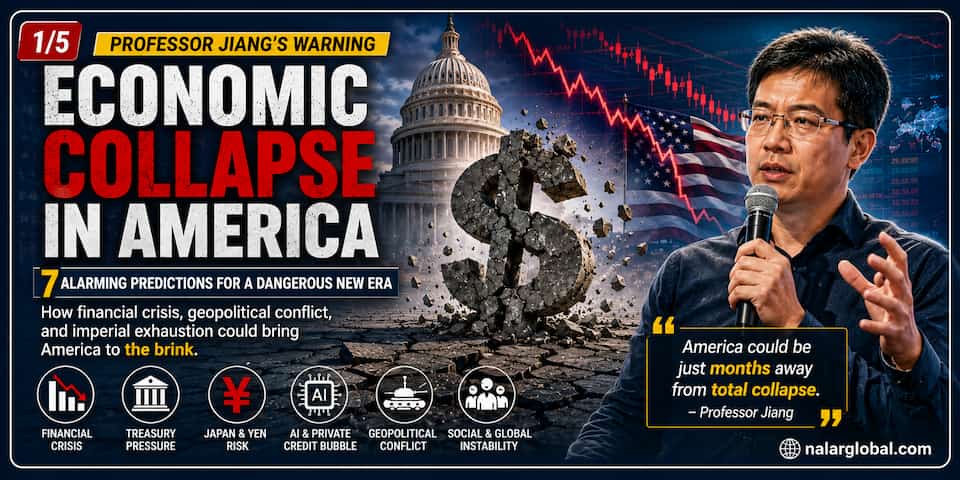
Could economic collapse in America happen within the next few months, as Professor Jiang predicts?
Quick Answer
According to Professor Jiang’s August 2026 forecast, economic collapse in America is no longer a distant possibility but an imminent systemic crisis. He argues that weakening global liquidity, pressure on Japan and the U.S. Treasury market, financial bubbles, geopolitical conflict, and American imperial exhaustion could converge into a rapid breakdown. In his scenario, the consequences could extend far beyond Wall Street into employment, household finances, international trade, and national security.
When a Geopolitical Warning Starts Feeling Personal
Imagine waking up one morning and discovering that the financial system you have trusted for decades is suddenly behaving differently.
Your retirement account is falling. Credit becomes harder to obtain. Businesses begin delaying investments. Prices become unpredictable. And conversations that once sounded like distant geopolitical theory suddenly become part of ordinary American life.
That is the scenario Professor Jiang presented during his August 8, 2026 appearance in Venice, California, at the second Global Meet-Up of his “End of the World” U.S. tour. The event was described as a framework for understanding how the current international system developed and where Jiang believes it is heading.
Jiang Xueqin—widely known online as “Professor Jiang”—is a Beijing-based educator and geopolitical commentator whose Predictive History channel focuses on historical patterns, geopolitics, and long-term forecasting. Outside the source material, public profiles identify him as a high-school educator rather than a university professor, so the “Professor” label should be understood as his public media persona rather than a conventional university rank.
What makes his latest warning especially striking is its timing. Jiang does not describe economic collapse in America as the result of one isolated event. Instead, he portrays the United States as a system under pressure at several interconnected points simultaneously.
His argument begins with the post-World War II financial order, moves through the rise of the dollar-centered global economy, and ends with a much darker possibility: that the system established after 1944 is approaching its final stage.
Table of Contents
- What Professor Jiang Means by Economic Collapse in America
- How the Postwar Dollar System Created American Power
- Why Jiang Says American Imperial Decline Has Three Causes
- Why Japan and U.S. Treasury Demand Matter
- The AI and Private-Credit Bubble Warning
- How Geopolitical Conflict Could Accelerate the Crisis
- What Americans Should Do If the Forecast Comes True
- Recommended Actions to Take & Things to Avoid for People of United States
- Conclusion
What Professor Jiang Means by Economic Collapse in America
Professor Jiang’s central argument is not simply that the stock market might crash. He describes a systemic collapse, in which several parts of the American and global financial architecture begin failing together.
In his view, the modern system depends heavily on international liquidity flowing into U.S. financial markets and Treasury securities. If that liquidity weakens substantially, he believes the consequences could spread through financial markets, private credit, artificial-intelligence investment, and ultimately the wider American economy.
Why This Is Different From an Ordinary Recession
A normal recession can be painful without destroying the underlying financial system. Companies reduce hiring, consumers spend less, and policymakers attempt to stabilize demand.
Jiang’s scenario is considerably more severe. He describes a chain reaction in which declining confidence and shrinking liquidity reinforce one another until conventional policy tools become increasingly ineffective.
He calls this condition “imperial exhaustion.” In his interpretation, the United States has accumulated financial, military, and institutional burdens that are becoming increasingly difficult to sustain.
How the Postwar Dollar System Created American Power
Jiang traces the roots of the present system to the final years of World War II. He argues that America’s enormous industrial capacity after the war helped establish the dollar-centered international order and allowed the United States to become the central financial power of the postwar world.
He then connects the transition away from the gold standard in 1971 with the emergence of a new system built around the dollar, global trade, oil, Asian manufacturing, and American financial markets.
According to Jiang, this transformation gradually shifted the United States away from being primarily a manufacturing powerhouse toward becoming a financial and consumption-driven economy.
That shift, he argues, produced enormous benefits but also created vulnerabilities—including inequality, financial speculation, and growing dependence on global capital flows.
Why Jiang Says American Imperial Decline Has Three Causes
Jiang identifies three major forces behind what he calls American imperial decline: financialization, bureaucratization, and elite overproduction.
Financialization
His first concern is that financial speculation can become more attractive than building businesses, factories, or other forms of productive capacity. In such an environment, capital increasingly flows toward financial assets rather than physical economic expansion.
Bureaucratization and Elite Competition
His second argument concerns expanding bureaucracies and institutions. Jiang believes organizations created to coordinate society can eventually become self-preserving systems that consume increasing resources.
The third factor is what he calls elite overproduction: competition between established financial elites and newer technology-based elites for influence over Washington and the direction of the American economy.
Why Japan and U.S. Treasury Demand Matter
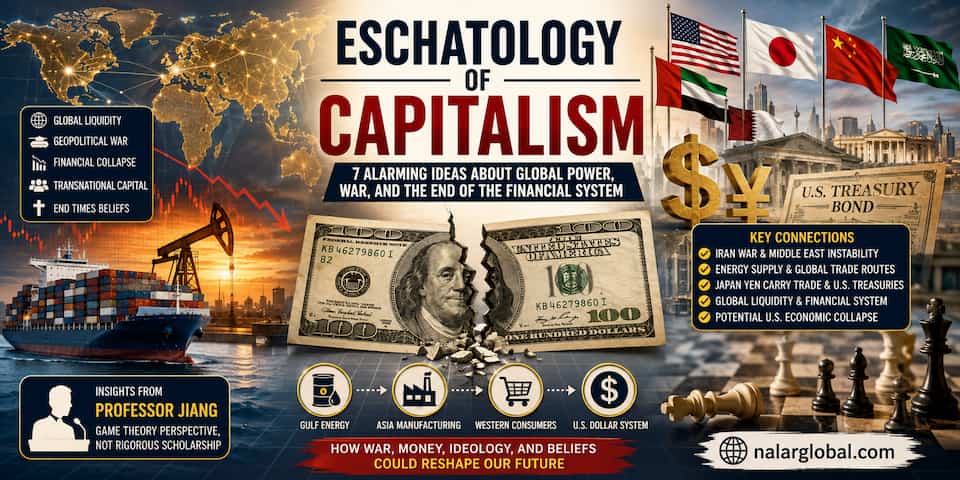
One of the most important parts of Professor Jiang’s forecast focuses on Japan. He argues that Japan and Middle Eastern economies have historically supplied substantial liquidity to global financial markets, including demand for U.S. Treasury securities.
Why Japan Becomes a Critical Pressure Point
Jiang argues that a significant deterioration in Japan’s financial position could weaken one of the mechanisms supporting the broader dollar-centered system. In his scenario, declining capacity or willingness to purchase U.S. Treasuries could reduce the liquidity available to American financial markets.
He presents this as a potential domino effect rather than an isolated Japanese problem. According to his argument, weakening liquidity could place additional pressure on U.S. stocks, artificial-intelligence investments, and private credit.
Jiang therefore treats Japan as an early warning signal. If the Japanese financial system becomes increasingly unstable while global investors simultaneously become less willing to hold U.S. assets, he believes the consequences could spread rapidly.
The AI and Private-Credit Bubble Warning
Jiang’s forecast becomes particularly dramatic when he discusses artificial intelligence and private credit.
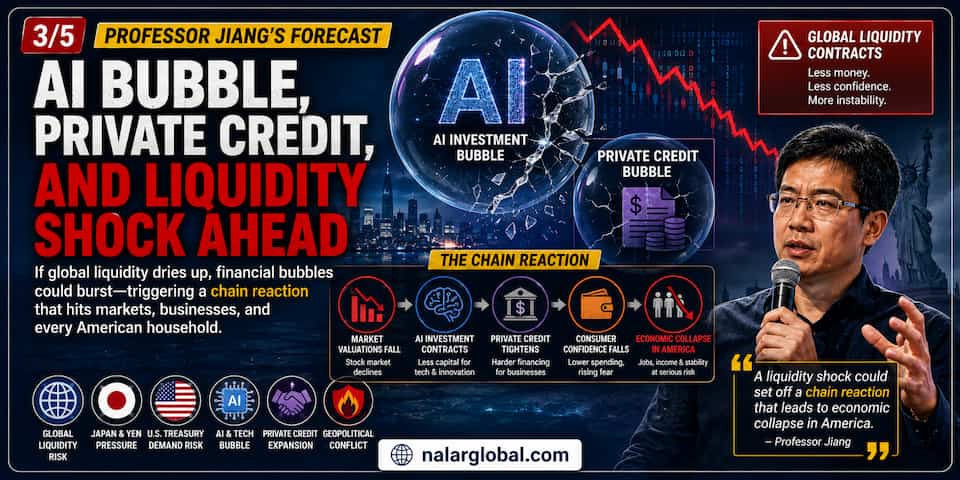
He argues that both areas have benefited from abundant global liquidity. If that liquidity suddenly dries up, he believes valuations and financing conditions could change very quickly.
What Could Happen If Liquidity Disappears?
In Jiang’s scenario, the sequence could look something like this:
| Potential Pressure | Possible Consequence |
|---|---|
| Global liquidity weakens | Less money available for financial markets |
| Treasury demand declines | Greater pressure on U.S. borrowing costs |
| Asset valuations fall | Stock-market losses |
| AI investment contracts | Reduced technology spending |
| Private credit tightens | Harder financing for businesses |
| Consumer confidence falls | Lower spending and economic activity |
The important point is that Jiang is describing a systems-collapse scenario, not merely predicting another bear market. He explicitly connects the possibility of financial-market instability with broader geopolitical and economic disruption.
How Geopolitical Conflict Could Accelerate the Crisis
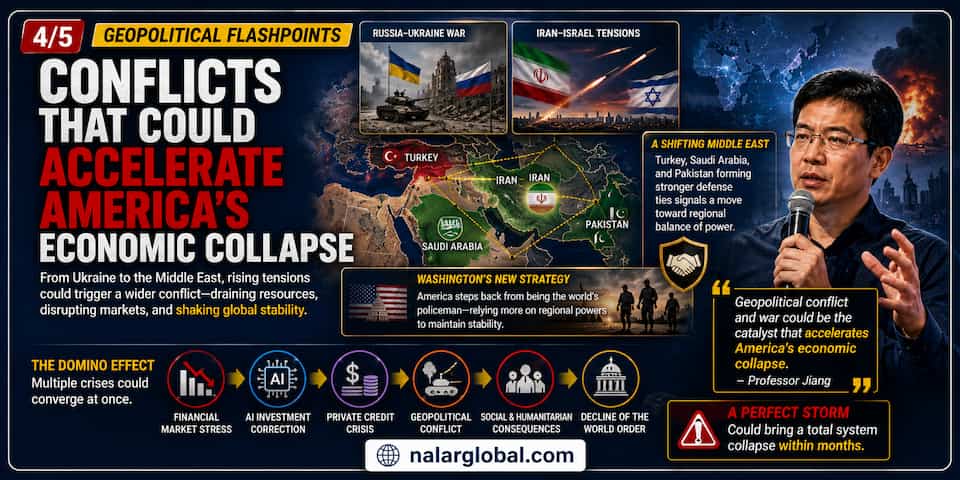
Professor Jiang also connects the financial system to geopolitical developments involving Russia, Ukraine, Iran, Israel, the Middle East, and the changing role of American military power.
His broader argument is that the United States has historically carried enormous security responsibilities around the world. As those commitments become increasingly expensive and difficult to maintain, he believes Washington is moving toward a balance-of-power strategy rather than attempting to guarantee security everywhere directly.
A Changing Middle East
Jiang discusses a reported defense relationship involving Turkey, Saudi Arabia, and Pakistan and interprets it as part of a broader transition in regional security. He argues that Washington increasingly wants regional powers to assume greater responsibility for maintaining the balance of power.
He also describes what he calls a transition from Pax Americana toward “Pax Judea” in the Middle East. This is Jiang’s interpretation of the geopolitical direction of the region, not an established consensus among international-relations scholars.
Why Jiang Believes the Crisis Could Become Much Larger
The most extreme version of Jiang’s forecast involves several crises converging simultaneously.
He predicts a possible combination of financial-market instability, an AI-sector correction, a private-credit crisis, geopolitical conflict, and weakening confidence in the American-led international order.
In his presentation, he says this convergence could produce severe economic disruption and even broader humanitarian consequences. He also argues that the conflicts involving Ukraine and Iran could eventually merge into a much larger global confrontation.
From Economic Anxiety to Social Anxiety
Perhaps the most human part of Jiang’s presentation comes when an audience member asks how young Americans should respond to such a frightening outlook.
Rather than recommending panic, Jiang argues that people should resist nihilism and helplessness. He emphasizes spirituality, family, meaning, and human relationships as sources of resilience during periods of uncertainty.
He later returns to the same theme, arguing that modern material prosperity does not automatically produce happiness. In his view, loneliness, meaninglessness, and spiritual disconnection can become serious problems even in highly developed societies.
What Americans Should Do If the Forecast Comes True
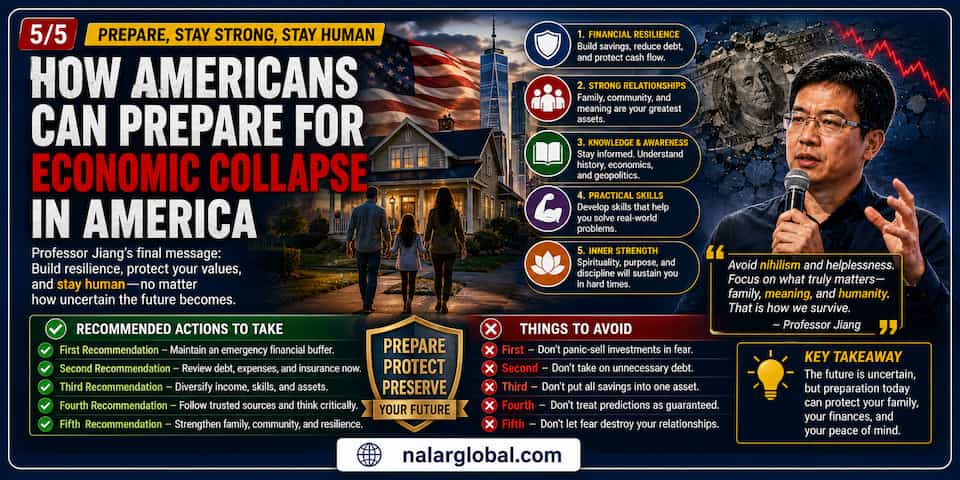
If we temporarily accept Jiang’s forecast as the scenario to prepare for, the most sensible response is not panic buying or abandoning ordinary financial judgment.
The practical lesson is resilience: reduce unnecessary financial vulnerability, maintain access to essential resources, understand household cash flow, and avoid making emotional decisions during market volatility.
Recommended Actions to Take & Things to Avoid for People of United States
Recommended Actions to Take ✔️
✔️ First Recommendation — Maintain a practical emergency financial buffer so temporary income disruption does not immediately become a household crisis.
✔️ Second Recommendation — Review debt, recurring expenses, insurance coverage, and essential monthly costs before conditions become more difficult.
✔️ Third Recommendation — Diversify your household’s sources of resilience rather than depending entirely on one job, one investment, or one income stream.
✔️ Fourth Recommendation — Follow major economic and geopolitical developments from multiple credible sources instead of relying exclusively on one commentator or political narrative.
✔️ Fifth Recommendation — Strengthen family relationships, community connections, practical skills, and emotional resilience because financial crises can become social and psychological crises as well.
Things to Avoid ❌
❌ First — Do not panic-sell investments simply because alarming predictions appear online.
❌ Second — Do not take on large amounts of debt based on the assumption that a financial collapse is guaranteed.
❌ Third — Do not put all of your savings into a single asset simply because someone predicts that it will survive a crisis.
❌ Fourth — Do not treat a geopolitical forecast as a certainty when real-world events can develop in unexpected ways.
❌ Fifth — Do not allow fear of economic collapse to destroy your relationships, mental balance, or ability to make rational decisions.
Conclusion
The warning about economic collapse in America presented by Professor Jiang is deliberately extreme. He argues that the United States is entering a period of imperial exhaustion in which financialization, bureaucratic expansion, elite competition, geopolitical overstretch, and dependence on global liquidity are converging into a dangerous system.
His most immediate concern is the possibility that weakening international liquidity—particularly involving Japan, U.S. Treasury demand, artificial-intelligence investment, and private credit—could trigger a much broader financial crisis. He believes that such a crisis could then interact with geopolitical conflicts and accelerate the transformation of the international order.
At the same time, the most useful lesson may not be predicting the exact date of a collapse. It is recognizing that households can become vulnerable whenever debt is excessive, savings are inadequate, income is concentrated, or decisions are driven by fear.
Jiang’s advice to younger people also offers an important counterweight to his darkest predictions: do not surrender to nihilism. Build meaningful relationships, protect your family, develop practical resilience, and maintain a sense of purpose even when the wider world feels unstable.
If his prediction proves correct, preparedness will matter. If it does not, financial prudence, strong relationships, and resilience will still have value.
Artikel ini hanya untuk tujuan edukasi. Silakan tinjau disclaimer lengkap kami: http://nalarglobal.com/en/disclaimer sebelum menerapkan informasi apa pun.
Frequently Asked Questions
1. What is Professor Jiang predicting about the American economy?
He predicts a possible systemic economic crisis involving financial markets, global liquidity, AI investments, private credit, and geopolitical instability.
2. When does Professor Jiang expect economic collapse in America?
In the presentation, Jiang says the United States could be only “a few months” away from a total system collapse. This is his forecast, not an established economic consensus.
3. Why does Professor Jiang focus on Japan?
He considers Japan an important source of global financial liquidity and argues that instability in the yen and Japan’s ability to purchase U.S. Treasuries could affect the broader financial system.
4. Could an AI bubble contribute to an American financial crisis?
According to Jiang’s scenario, yes. He argues that an AI investment bubble could become vulnerable if global liquidity contracts sharply.
5. What does “imperial exhaustion” mean?
Jiang uses the term to describe what he sees as the cumulative financial, military, institutional, and geopolitical exhaustion of the American-led international system.
6. Does Jiang believe the United States is already in economic collapse?
Yes. During the discussion, Jiang said he believes the American economy had already effectively collapsed and that the underlying problems date back to the aftermath of the 2008 financial crisis.
7. Does economic collapse in America automatically mean the end of the United States?
No. Even a severe recession or financial crisis would not necessarily mean the disappearance of the United States as a country. Jiang’s forecast describes a potential transformation of the existing international order.
8. What does Jiang recommend for young people?
His central message is to avoid nihilism and helplessness. He emphasizes family, spirituality, meaning, and human relationships as important sources of resilience.
9. Does Jiang believe America’s global role is changing?
Yes. He argues that Washington is moving away from acting as the direct guarantor of global security and increasingly relying on regional balance-of-power arrangements.
10. Should Americans panic about an economic collapse in America?
No. Even when a forecast is extremely serious, panic can make financial decisions worse. A more rational response is to strengthen household resilience, understand personal finances, and evaluate information critically.
Summary
The possibility of economic collapse in America is one of the most alarming themes in Professor Jiang’s August 2026 geopolitical presentation. His argument is that the United States is facing more than an ordinary recession. He describes a potential systemic crisis caused by the interaction of financialization, global liquidity problems, geopolitical conflict, institutional exhaustion, and America’s changing position in the international system.
Jiang places particular importance on Japan and the market for U.S. Treasury securities. In his scenario, weakening global liquidity could place pressure on American financial markets and expose vulnerabilities in areas such as artificial intelligence and private credit. He believes these financial pressures could interact with conflicts involving Russia, Ukraine, Iran, Israel, and the wider Middle East, creating a much larger crisis.
Another important part of his argument concerns the decline of American manufacturing and the increasing influence of financial and technology elites. Jiang identifies financialization, bureaucratization, and elite overproduction as three major forces behind what he calls American imperial decline.
Yet the presentation is not entirely about catastrophe. When asked what young people should do, Jiang argues against nihilism and helplessness. He emphasizes family, spirituality, purpose, and meaningful human relationships as ways of remaining grounded during periods of uncertainty.
Whether economic collapse in America occurs according to Jiang’s timeline remains uncertain. His forecast should therefore be understood as a scenario to examine rather than an established fact. For ordinary Americans, the practical response is resilience: maintain financial discipline, reduce unnecessary vulnerability, strengthen relationships, and avoid decisions driven by fear.



Meta Description: Economic collapse in America could trigger financial, geopolitical, and social turmoil. Explore 7 alarming predictions and practical steps for U.S. households.
References
YouTube
Professor Jiang — Geopolitical analyst and educator
Video: Global Meet-Up #2 (Los Angeles): The “End of the World” US Tour
Date: August 8, 2026
Location: The Kinn, Venice, California
Duration: 1:39:33
Video: https://www.youtube.com/watch?v=N2GFDDZtGQY
- Penulis: Professor Jiang
- Editor: TRS
- Sumber: https://www.youtube.com/watch?v=N2GFDDZtGQY










Saat ini belum ada komentar