
Breaking News
light_mode
Trending Tags
Beranda » Geopolitics » Geopolitical Weaponization of Migration : 7 Alarming Predictions That Could Reshape Europe

Geopolitical Weaponization of Migration : 7 Alarming Predictions That Could Reshape Europe

  • account_circle daffa313
  • calendar_month Sabtu, 22 Agt 2026
  • visibility 44
  • comment 0 komentar
  • print Cetak

info Atur ukuran teks artikel ini untuk mendapatkan pengalaman membaca terbaik.

Table of Contents

Main Question: What Is the Geopolitical Weaponization of Migration?

Quick Answer

Geopolitical Weaponization of Migration refers to the use of large-scale population movements as a means of creating political, economic, or strategic pressure on another country or region. In Professor Jiang’s analysis, the migration surge into Spain’s Ceuta enclave is presented not simply as a border crisis, but as part of a wider geopolitical struggle involving Europe, Morocco, the United States, Israel, and strategically important maritime chokepoints.
Imagine waking up to images of thousands of people suddenly crossing a border that normally appears quiet and heavily controlled.
For residents, the immediate concern is obvious: safety, housing, public services, jobs, and the ability of authorities to maintain order. But Professor Jiang argues that the deeper story may be much larger.
In his Emergency Discussion #2, titled The Blackmailing of Spain, Professor Jiang examines the events surrounding Ceuta and asks a provocative question: what happens when migration becomes more than a humanitarian and immigration issue—and becomes a source of geopolitical leverage?
The discussion focuses on Ceuta, a small Spanish enclave on the North African coast. The presentation describes the territory as having roughly 80,000 residents and discusses reports of tens of thousands of migrants arriving from Morocco.
The argument becomes increasingly strategic. According to the analysis, migration pressure could be connected to broader competition over Europe, North Africa, and the maritime routes linking the Atlantic and Mediterranean to global commerce.
That makes the Geopolitical Weaponization of Migration an issue worth understanding—not because every interpretation of a geopolitical event should automatically be accepted, but because the consequences of such a strategy, if the prediction is correct, could extend far beyond immigration policy.


Professor Jiang’s Geopolitical Warning

Professor Jiang presents the discussion as an emergency examination of what he describes as a potentially world-changing event. He says the purpose is to understand what is happening in Ceuta, what may be causing it, and what geopolitical repercussions could follow.
The central idea is straightforward but unsettling: migration can become leverage when the movement of people creates political pressure that governments cannot easily absorb.
In this interpretation, the vulnerability is not limited to Spain. Migration entering Spain, Italy, or Greece can potentially affect the wider European system because migrants may seek to move onward toward wealthier northern European countries.
That creates a chain reaction.
A border event in North Africa can become a Spanish political crisis. The Spanish crisis can become a European Union problem. And a European political problem can eventually become a geopolitical opportunity for outside powers seeking greater influence.


Table of Contents

  1. What Is the Geopolitical Weaponization of Migration?
  2. Professor Jiang’s Geopolitical Warning
  3. Why Ceuta Matters
  4. From Migration Crisis to Geopolitical Leverage
  5. Migration as a Strategic Pressure Point
  6. The Hidden Strategic Layer: Maritime Chokepoints
  7. Why the Strait of Gibraltar Could Become a Flashpoint
  8. How the Ceuta Crisis Could Become a Wider Geopolitical Contest
  9. Europe’s Internal Vulnerability
  10. From Gibraltar to the Strait of Malacca
  11. Why Indonesia Matters in Professor Jiang’s Prediction
  12. China’s “Malacca Dilemma” and the Arctic Route
  13. Greenland Enters the Picture
  14. The Three-Chokepoint Theory
  15. The Bigger Prediction: A Changing Global System
  16. What This Could Mean for Americans
  17. The Five Priorities for American Households
  18. Why Migration Could Become a Geopolitical Weapon
  19. The Human Cost Should Not Be Forgotten
  20. Seven Indicators Americans Should Watch
  21. Final Assessment: What Should Americans Take From This?
  22. Conclusion
  23. Frequently Asked Questions
  24. Summary
  25. References

Geopolitical Weaponization of Migration
Geopolitical Weaponization of Migration1
previous arrow
next arrow


Why Ceuta Matters

Ceuta is strategically unusual. It is Spanish territory located on the African continent, immediately adjacent to Morocco. The transcript describes the enclave as extremely small compared with the scale of the reported migration surge.
That geographic reality is important because it concentrates enormous political pressure into a very small physical space.
When tens of thousands of people arrive in an area designed for a much smaller population, the issue is no longer simply about immigration numbers. It becomes a question of whether local infrastructure, border enforcement, emergency services, and political institutions can withstand sudden pressure.
This is where the concept of Geopolitical Weaponization of Migration becomes central to Professor Jiang’s argument.
The analysis contends that migration pressure can function like a strategic lever: the more vulnerable a society feels to uncontrolled population movement, the greater the potential political pressure on its government.

From Migration Crisis to Geopolitical Leverage

The transcript goes further by arguing that Europe’s migration experience after 2015 left deep political and social consequences. Professor Jiang connects those memories to fears surrounding another large migration wave, particularly from Africa.
Whether one agrees with every part of this interpretation or not, the strategic logic is easy to understand.
Governments respond not only to the number of migrants crossing a border but also to public perceptions of control. If citizens believe their government has lost control of its borders, political pressure can rise rapidly.
That pressure can influence elections, coalition governments, foreign policy, border agreements, and relationships between neighboring states.

Migration as a Strategic Pressure Point

Professor Jiang describes migration as a potential “new weapon” against European governments. His argument is that external actors could exploit European fears about migration to influence political decisions.
Under the prediction presented in the discussion, the mechanism would work through political vulnerability rather than conventional military force.
There would be no need for tanks crossing a European border. Instead, pressure would emerge through migration flows, public anxiety, political polarization, and the resulting demand for stronger border controls.
The consequence could be profound: European countries might begin prioritizing national responses over collective European solutions.
That matters because the European Union depends heavily on cooperation and relatively open internal borders. The transcript specifically points to the possibility that migration pressure could contribute to renewed national border controls and tensions within Europe.

The Hidden Strategic Layer: Maritime Chokepoints

The analysis does not stop at migration.
Professor Jiang connects the Ceuta situation to a much broader geopolitical map involving the Strait of Gibraltar, Strait of Malacca, and Arctic route. These waterways and passages are presented as strategic chokepoints through which major portions of global trade must move.
This changes the meaning of the crisis.
If migration is the visible pressure point, maritime access may be the deeper strategic prize.
The transcript argues that control or influence over these chokepoints could provide enormous economic and geopolitical leverage. In the case of Gibraltar, the discussion connects Ceuta and Morocco to the broader question of who ultimately has influence over maritime traffic between the Atlantic and Mediterranean.
For Americans, this is particularly important because disruptions in major shipping routes can eventually affect energy prices, transportation costs, consumer goods, inflation, and the wider economy.
The average American does not need to live anywhere near Gibraltar or the Mediterranean to feel the consequences of a geopolitical struggle over global trade routes.

Why the Strait of Gibraltar Could Become a Flashpoint

The Strait of Gibraltar sits at one of the most strategically important maritime gateways in the world. The transcript describes the area as involving British-controlled Gibraltar, Spain, and Morocco, while presenting Ceuta as an important piece of the broader geopolitical puzzle.
Professor Jiang’s prediction is that the struggle surrounding Ceuta could eventually become connected to control over this maritime chokepoint.
If that prediction proves correct, the significance of migration would extend far beyond immigration policy.
A humanitarian and border crisis could become connected to trade routes, military alliances, energy security, and the balance of power between the United States, Europe, Morocco, Israel, China, and other actors.


How the Ceuta Crisis Could Become a Wider Geopolitical Contest

The most consequential part of Professor Jiang’s argument begins when the discussion moves beyond Spain. In his interpretation, the Geopolitical Weaponization of Migration is connected to a broader struggle over strategic territory and maritime access.
The central question becomes: if migration can create political pressure inside Europe, what happens when that pressure coincides with competition over the world’s most important shipping routes?

The Strait of Gibraltar as a Strategic Pressure Point

Professor Jiang argues that Ceuta matters partly because of its proximity to the Strait of Gibraltar. In his analysis, gaining greater influence around Ceuta could eventually affect the balance of power surrounding the strait and therefore maritime trade between the Mediterranean and Atlantic.
This is where the Geopolitical Weaponization of Migration takes on a second dimension.
Migration becomes the visible crisis. Maritime geography becomes the strategic layer underneath it.
The transcript describes the Strait of Gibraltar as a critical maritime chokepoint and argues that control over such locations can create significant economic leverage.
For policymakers, that distinction matters. A migration crisis can be temporary, while control over a strategic maritime corridor can affect international commerce for decades.

Europe’s Internal Vulnerability

Why Migration Could Test European Unity

Professor Jiang argues that the migration issue could put additional pressure on the European Union because migrants entering countries such as Spain, Italy, or Greece may seek to continue toward wealthier northern European countries.
That creates a difficult political dilemma.
A country at the external border may demand greater assistance from its European partners. Countries farther north may worry about becoming the eventual destination. Political leaders then face pressure from voters to restore tighter national controls.
In this scenario, the Geopolitical Weaponization of Migration would work indirectly. It would not necessarily require an actor to control every migrant. Political divisions themselves could become the strategic outcome.
The transcript explicitly suggests that migration pressure could encourage European states to reintroduce stronger national borders and potentially weaken European integration.
However, this remains Professor Jiang’s interpretation. The transcript does not independently establish that the migration surge was deliberately engineered by a particular foreign government for this purpose.

From Gibraltar to the Strait of Malacca

The analysis then shifts dramatically from Europe to Southeast Asia.
Professor Jiang identifies the Strait of Malacca as another major maritime chokepoint and links it to the strategic vulnerability of China, whose trade heavily depends on maritime routes through the region.
For Americans, this part of the argument is especially significant because it places Southeast Asia inside the same geopolitical framework as Gibraltar.
Indonesia becomes important because of its geographic position around one of the world’s major commercial waterways.

Why Indonesia Matters in Professor Jiang’s Prediction

Professor Jiang predicts that closer U.S.–Indonesia military cooperation could eventually have consequences for control and security around the Strait of Malacca. He specifically describes a possible future flare-up between Indonesia and Malaysia, while acknowledging that this is a prediction conditional on his broader analysis being correct.
That distinction is crucial.
The source does not establish that Indonesia and Malaysia are destined for conflict. Rather, Professor Jiang presents a hypothetical geopolitical scenario in which competition over maritime access becomes more intense.
For the United States, the strategic implication in his framework is clear: control or influence over maritime chokepoints could become increasingly important as competition with China intensifies.

China’s “Malacca Dilemma” and the Arctic Route

The next part of the argument introduces another strategic pathway: the Arctic.
Professor Jiang says China recognizes its dependence on the Strait of Malacca and has therefore sought alternative routes to Europe through the Arctic.
This creates a three-part geopolitical map:
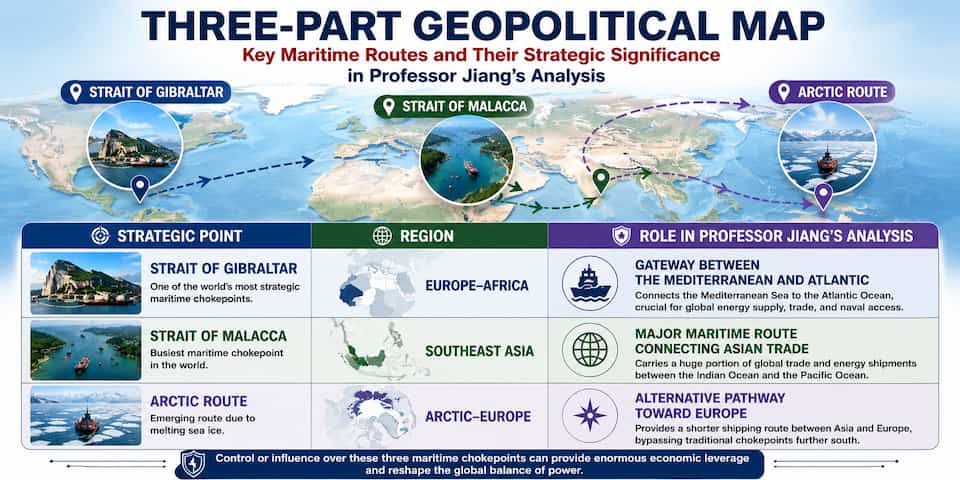
Geopolitical Weaponization of Migration

Geopolitical Weaponization of Migration – Geopolitical MapThe significance of these locations is not simply geographical. In Professor Jiang’s interpretation, controlling or influencing multiple chokepoints could constrain China’s ability to move goods toward European markets. This is one of the strongest examples of how the Geopolitical Weaponization of Migration thesis expands beyond migration itself. The migration crisis around Ceuta becomes one component of a much larger theory involving territory, shipping lanes, military alliances, and economic competition.


Greenland Enters the Picture

Professor Jiang then connects the Arctic route to Greenland.
In his prediction, Greenland could become an important strategic asset because of its position between North America and Europe. He argues that control of Greenland would help restrict China’s alternative Arctic access to Europe.
This is an exceptionally ambitious geopolitical prediction.
It also demonstrates why readers should distinguish between analysis and established fact. The transcript presents these developments as part of Professor Jiang’s forecast rather than as events that have already occurred.
Nevertheless, the strategic logic is easy to follow: if major powers compete for access to global trade routes, geography becomes an increasingly valuable form of power.


The Three-Chokepoint Theory

Professor Jiang ultimately links the Strait of Gibraltar, Strait of Malacca, and Arctic route into a single strategic framework. He argues that controlling these three locations would severely constrain China’s access to Europe.
This is the point where the Geopolitical Weaponization of Migration becomes part of an even broader theory of global power competition.
The basic sequence of his argument can be summarized this way:
Migration pressure → political instability → pressure on European governments → strategic territorial changes → control of maritime chokepoints → wider economic consequences.
That sequence is Professor Jiang’s analytical framework. It should not be confused with independently verified evidence establishing that every link in the chain is already occurring.


The Bigger Prediction: A Changing Global System

Near the end of the discussion, Professor Jiang moves beyond Ceuta, migration, and maritime chokepoints altogether.
He argues that the world is not merely witnessing the decline of American power. His larger prediction is what he calls the collapse of transnational capital, accompanied by a relocation of economic and political power.
This is the broadest claim in the discussion.
Under this worldview, migration, military alliances, economic crises, territorial disputes, and maritime competition are not isolated events. They are symptoms of a deeper transformation in the global system.
For readers in the United States, that means the consequences could theoretically reach everyday life through trade disruptions, energy prices, inflation, financial markets, employment, and geopolitical uncertainty.
But again, the responsible way to read this material is to separate what has been observed from what Professor Jiang predicts.

What Americans Should Watch

If the scenario presented in the discussion proves correct, several indicators would deserve particular attention.
First, sustained migration pressure at Europe’s external borders could become politically significant. Second, renewed European border controls could indicate growing tension between national governments and European integration. Third, developments involving Gibraltar, Malacca, Greenland, and Arctic shipping routes could reveal whether maritime competition is becoming more intense.
Finally, U.S. relationships with countries positioned around strategic waterways would deserve close attention.
The larger lesson is not that a particular prediction must happen. It is that Geopolitical Weaponization of Migration should be understood as a possible mechanism through which humanitarian crises, domestic politics, and international power competition can intersect.


What This Could Mean for Americans

If we assume Professor Jiang’s predictions are correct, the most important question is no longer whether the United States can prevent every geopolitical shock. It is whether ordinary Americans can remain economically and socially resilient when several shocks occur at the same time.
The scenario described in the discussion combines migration pressure, European political instability, competition over maritime chokepoints, U.S.–China rivalry, energy disruption, and broader systemic stress. Professor Jiang ultimately places these developments within his larger prediction about the collapse of transnational capital.
That would create a very different environment from a conventional recession.
A household could face higher energy costs while financial markets become volatile. A business could experience supply disruptions while consumers reduce spending. A geopolitical confrontation could therefore reach Americans through their wallets long before it reaches them through military conflict.
This is why preparedness matters.


The Five Priorities for American Households

1. Build a Stronger Financial Buffer

If geopolitical instability causes energy prices, food prices, transportation costs, or unemployment to rise, households with no financial reserves will have the fewest options.
An emergency fund is therefore more than a personal-finance recommendation under this scenario. It becomes a form of household resilience.
Americans should prioritize maintaining accessible savings before making aggressive investments based solely on predictions of an impending geopolitical crisis.

2. Reduce Dependence on a Single Income Source

The Geopolitical Weaponization of Migration scenario described by Professor Jiang assumes that instability can spread across borders and economic systems.
If that happens, a job that appears secure today may not remain equally secure tomorrow.
A second source of income—freelancing, consulting, a small business, digital work, skilled trades, or another legitimate source—can provide additional flexibility.
The goal is not to become obsessed with preparing for catastrophe. The goal is to avoid having one unexpected event destroy an entire household’s financial stability.

3. Strengthen Practical and Digital Skills

Skills can become an economic form of resilience.
People who can work across industries, communicate effectively, use digital tools, analyze information, manage projects, or provide services remotely may have more options when local economic conditions deteriorate.
Under the scenario presented in the discussion, adaptability could become increasingly valuable as trade patterns and geopolitical relationships change.

4. Understand Where Critical Goods Come From

Geopolitical risk does not stay on a map.
The United States depends on complex international supply chains for energy, technology, industrial components, medicines, food inputs, and consumer products.
The Professor Jiang scenario emphasizes maritime chokepoints such as Gibraltar, Malacca, and the Arctic route.
If one or more of these routes becomes seriously disrupted, Americans could eventually experience the consequences through shortages, delays, or higher prices.
Understanding supply-chain dependence therefore becomes a practical form of preparedness.

5. Protect Social Stability

The most dangerous consequence of the Geopolitical Weaponization of Migration may not be economic.
It could be social polarization.
When people become frightened about jobs, immigration, crime, inflation, or national security, political narratives can become increasingly extreme. A population that stops trusting everyone outside its own political or social group becomes easier to divide.
Americans should therefore be careful about narratives that turn migrants, ethnic groups, religious communities, or foreign populations into universal explanations for complex economic problems.


Recommended Actions to Take ✔️

✔️ First Recommendation: Build and maintain an emergency savings reserve before making speculative investments based on geopolitical predictions.
✔️ Second Recommendation: Develop at least one additional income source that can continue operating if the primary job or industry experiences disruption.
✔️ Third Recommendation: Strengthen practical, digital, technical, communication, and financial skills that remain useful across different industries.
✔️ Fourth Recommendation: Follow reliable information about energy, trade, supply chains, maritime security, and international relations rather than relying exclusively on viral geopolitical content.
✔️ Fifth Recommendation: Protect community relationships and avoid allowing geopolitical fear to turn Americans against immigrants, ethnic groups, religions, or other communities.

Things to Avoid ❌

❌ First: Do not treat Professor Jiang’s predictions as guaranteed events and make extreme financial decisions based solely on them.
❌ Second: Do not spread dramatic geopolitical claims without checking the original context, evidence, and competing explanations.
❌ Third: Do not blame migrants collectively for economic, political, or security problems that have multiple causes.
❌ Fourth: Do not put all of your savings into a single asset simply because you believe geopolitical collapse is imminent.
❌ Fifth: Do not sacrifice long-term American interests by assuming that every international problem must be solved through confrontation with another major power.


The Most Important Warning About the Prediction

There is a crucial distinction between preparing for a scenario and believing that the scenario is certain to happen.
Professor Jiang’s discussion is intentionally provocative. He presents a chain of geopolitical interpretations that connects Ceuta, Morocco, Spain, Europe, Israel, the United States, China, Greenland, and several maritime chokepoints. The transcript also contains strong claims about deliberate coordination and strategic intentions.
Those claims should remain attributed to Professor Jiang.
For this article, however, the requested thought experiment is different: What if his predictions are correct?
Under that assumption, the logical response is preparation rather than panic.
A financially resilient household, a diversified workforce, a population capable of evaluating information critically, and a society capable of maintaining cooperation would be considerably better positioned than one consumed by fear.

Why Migration Could Become a Geopolitical Weapon

The concept of Geopolitical Weaponization of Migration rests on a simple vulnerability: governments must respond to human beings.
A conventional military attack can trigger a clearly defined national-security response. A migration wave is much more complicated. People crossing borders may be refugees, economic migrants, families seeking safety, or individuals with entirely different motivations.
That ambiguity creates a difficult political environment.
Professor Jiang argues that European governments could be pressured because they cannot simply respond to migrants as if they were an invading army. He compares this dynamic to a form of strategic coercion in which the humanitarian character of migration limits the military options available to governments.
This is the central logic behind the Geopolitical Weaponization of Migration thesis.
The people involved may have their own reasons for moving. Yet the movement itself can still produce geopolitical consequences.

The Human Cost Should Not Be Forgotten

There is another side of this debate that deserves attention.
Behind every geopolitical map are human beings.
A migrant is not automatically a geopolitical actor. A refugee fleeing war is not responsible for the strategic decisions of governments. A family crossing a border does not necessarily understand the political forces operating around them.
That distinction matters because treating human beings solely as geopolitical instruments can produce dangerous dehumanization.
Even if Professor Jiang’s predictions are assumed to be correct, the appropriate response should remain focused on policies, governments, institutions, and strategic interests—not collective blame against ordinary people.

Seven Indicators Americans Should Watch

If the predicted scenario begins unfolding, several developments would deserve attention:

  1. Persistent migration pressure at Europe’s external borders.
  2. Increasing European national border controls.
  3. Growing political conflict between European governments.
  4. Rising strategic competition around the Strait of Gibraltar.
  5. Greater U.S. and Chinese competition around the Strait of Malacca.
  6. Accelerating competition over Arctic shipping routes and Greenland.
  7. Increasing disruption to international trade and financial systems.
    These indicators follow the architecture of Professor Jiang’s argument, particularly his emphasis on Gibraltar, Malacca, and the Arctic route as strategic chokepoints.

Final Assessment: What Should Americans Take From This?

The deepest lesson is not that Professor Jiang must be right.
It is that geopolitical systems can produce consequences far beyond the places where the original conflict occurs.
Ceuta is a small territory. The Strait of Gibraltar is a narrow waterway. The Strait of Malacca is thousands of miles away. Greenland is separated from the continental United States by a vast ocean.
Yet in Professor Jiang’s framework, all three become connected through the movement of people, trade, military power, and economic influence.
That is why the Geopolitical Weaponization of Migration deserves attention as a concept even when individual predictions remain uncertain.
For Americans, the practical response is straightforward: strengthen financial resilience, maintain multiple economic options, improve information literacy, understand supply-chain vulnerabilities, and protect social cohesion.
If the prediction fails, those preparations are still useful.
If the prediction succeeds, they may become essential.


Conclusion

The Geopolitical Weaponization of Migration is one of the most provocative ideas presented in Professor Jiang’s Emergency Discussion #2: The Blackmailing of Spain. His argument begins with the reported migration surge into Ceuta and expands into a much larger theory involving Spain, Morocco, Europe, the United States, China, Greenland, and strategically important maritime chokepoints.
The discussion identifies the Strait of Gibraltar, Strait of Malacca, and Arctic route as critical pieces of a broader geopolitical contest. Professor Jiang argues that control or influence over these routes could have consequences for China’s access to Europe and for the wider balance of power.
If we assume his predictions are correct, Americans should not respond with panic. They should prepare. Financial reserves, diversified income, useful skills, reliable information, and strong community relationships would become important forms of resilience in a more unstable global environment.
At the same time, the human dimension must remain visible. Migrants and refugees should not automatically be treated as enemies or blamed for geopolitical decisions made by governments and powerful institutions.
The Geopolitical Weaponization of Migration ultimately demonstrates how migration, economics, maritime geography, and international power can intersect. Whether every prediction comes true remains uncertain, but understanding the scenario allows ordinary Americans to think more clearly about risks that could eventually reach their homes, jobs, communities, and finances.
This article is for educational purposes only. Please review our full disclaimer: http://nalarglobal.com/en/disclaimer before applying any information provided here.


Frequently Asked Questions

1. What is the Geopolitical Weaponization of Migration?

The Geopolitical Weaponization of Migration is the concept that migration flows can be used, deliberately or indirectly, to create political pressure on another country or region. Professor Jiang applies this concept to his analysis of the Ceuta crisis and European politics.

2. Why is Ceuta important?

Ceuta is a Spanish enclave located on the North African coast near the Strait of Gibraltar. Its small geographic and demographic scale makes a sudden large migration movement potentially disruptive.

3. Does Professor Jiang claim that migration was deliberately organized?

Yes. Professor Jiang argues in the discussion that there was coordination behind the movement of migrants and presents video footage as part of his argument. These are his claims and interpretations; they should not automatically be treated as independently established facts.

4. How could migration become a geopolitical weapon?

The theory is that large-scale migration can create political pressure by overwhelming border systems, increasing public anxiety, and forcing governments to make difficult domestic and foreign-policy decisions.

5. What does the Strait of Gibraltar have to do with migration?

In Professor Jiang’s framework, Ceuta’s geographic position near Gibraltar connects the migration issue to a much larger struggle over maritime access and strategic influence.

6. Why is the Strait of Malacca important to Americans?

The Strait of Malacca is a major maritime route in Asia. Professor Jiang connects it to China’s dependence on maritime trade and to broader U.S.–China strategic competition.

7. Why does Greenland appear in the analysis?

Professor Jiang connects Greenland to Arctic access and argues that control of Greenland could affect China’s ability to use Arctic routes toward Europe. This is presented as his geopolitical prediction, not an established future event.

8. Should Americans prepare for geopolitical collapse?

Americans can reasonably prepare for economic and geopolitical uncertainty without assuming collapse is inevitable. Emergency savings, diversified skills, and reliable information are useful regardless of whether the prediction materializes.

9. Should Americans be afraid of migrants?

No. A migration policy debate should not become collective hostility toward migrants or refugees. Individual migrants should not automatically be blamed for geopolitical decisions made by governments.

10. What is the most practical lesson from Professor Jiang’s prediction?

The practical lesson is resilience. Households should strengthen their finances, skills, income options, information literacy, and social networks rather than making extreme decisions based on fear.


Summary

The Geopolitical Weaponization of Migration describes the possibility that migration flows can become a source of political and strategic pressure. Professor Jiang uses the situation surrounding Ceuta as the starting point for a much broader geopolitical argument involving Spain, Morocco, Europe, the United States, China, and several strategic maritime routes.
His analysis argues that migration pressure can expose political vulnerabilities inside Europe. Countries located on Europe’s external borders may face the immediate pressure, while migrants can continue toward wealthier northern European states. This creates the possibility of political disputes over borders, responsibility, security, and European integration.
The discussion then expands beyond migration. Professor Jiang identifies the Strait of Gibraltar, Strait of Malacca, and Arctic route as strategically important chokepoints. In his framework, control over these routes could influence China’s access to Europe and become part of an increasingly intense global competition.
The United States therefore cannot view the issue purely as a European immigration problem. If the predicted geopolitical chain develops, Americans could eventually experience its consequences through energy prices, supply chains, financial markets, employment, and international trade.
The appropriate response is not panic. If the Geopolitical Weaponization of Migration scenario becomes reality, financial reserves, diversified income, adaptable skills, information literacy, and social cohesion could provide meaningful protection.
At the same time, the human dimension must remain central. Migrants and refugees should not automatically be treated as enemies or blamed for geopolitical strategies that may be designed by governments and powerful institutions.
Ultimately, the Geopolitical Weaponization of Migration is best understood as a warning about how humanitarian movement, domestic politics, economics, geography, and great-power competition can intersect.


Meta Description

Geopolitical Weaponization of Migration could reshape Europe, maritime trade, and U.S. strategy. Explore 7 alarming predictions and their global consequences.


References

YouTube

• Professor Jiang — geopolitical/history lecturer and creator of Predictive History — Emergency Discussion #2: The Blackmailing of Spain — Watch the video on YouTube

Podcast / Transcript

• Emergency Discussion #2: The Blackmailing of Spain — Professor Jiang — approximately 3 hours, discussing Ceuta, migration, Spain, Europe, and geopolitical repercussions.

  • Penulis: daffa313

Comments (0)

Saat ini belum ada komentar

Silahkan tulis komentar Anda

Email Anda tidak akan dipublikasikan. Kolom yang bertanda bintang (*) wajib diisi

Recommended for You

expand_less